Sunday, March 10, 2024

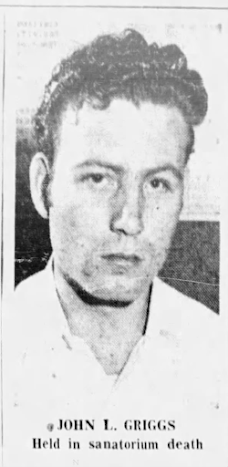
Murder At Waverly Hills Sanatorium


Instead of typing out an entire blog on this case, I decided to share the newspaper clipping from the Louisville Courier-Journal, Louisville, KY, March 2, 1954 along with subsequent articles.


Louisville Courier-Journal, Louisville, KY, March 2, 1954 


Louisville Courier-Journal, March 6, 1954.


Louisville Courier-Journal, April 22,1954


Tuesday, March 5, 2024

A Lynching In Rowan

 The following story was written by Dr. Jack Ellis and published in the Morehead News on July 7, 2000.  The Morehead News is no longer in publication and Dr. Ellis has since passed on.  So to keep this story from being lost to the sands of time, I thought I would publish it here, word for word, just as Dr. Ellis wrote it.


If a man be just, and do that which is lawful and right ... he shall surely live. Eze 18:5,9.


Evidence of early Rowan County's lawless and violent reputation was evident by an article that appeared in the "Bracken County Record" dated April 4, 1877. (Thanks to Nan Lytle for sharing this material)

The crime committed

John R. (Jack) Tabor was a Rowan resident who had resided in the Cranston area of Rowan County. Mr. Tabor had been in trouble with the law on several occasions. He had an unsavory reputation not only in Rowan but also in the neighboring counties. John P. Martin was one of Tabor's neighbors, and a companion in crime.

On a Saturday night in early April 1887 after getting drunk on their homemade moonshine, Tabor and Martin hatched a plan to steal two horses and skip the country. After stealing the horses, the two men headed north toward the Ohio River. On Sunday, they were seen passing through Flemingsburg. By Monday morning they reached the Ohio River at Foster, a small town down river from Augusta in Bracken County. It was their intention to board the Bonanza, a paddle wheeler, headed 42 miles down river to Cincinnati. There they would sell their stolen horses at the stock sales'.

The Bonanza was not 'due at Foster until Wednesday, so the two men camped on the dock waiting for the arrival of the steamboat. Also a part of their plan was for John Martin's wife to come to Maysville and board the Bonanza. She would then meet them down river when the boat docked at Foster. There the three would continue on to Cincinnati together. Martin's wife booked passage on the Bonanza on Tuesday right on schedule. But she evidently caught the attention of the local Marshall since he had just been notified of the two horses stolen in Rowan County. Also he had been told that the woman waiting to board the boat was from Rowan County.

When the Bonanza left Maysville headed down river, Maysville Marshall Heflin and Jail er Weedon were also on board. They were determined to "shadow" Mrs. Martin, believing she was involved in the crime. How did the Marshall in Maysville find out so quickly about the stolen horses in Rowan County? There were no railroads or any form of fast communication in Rowan County in 1877.

The news spreads Warren Alderson, owner of one of the two general stores in Morehead in 1877, was a church-going man. He arose on Sunday morning and attended church services held in the Rowan County Courthouse. As he came out of the meeting, he saw the sheriff ride up on his horse. The sheriff told Mr. Alderson that two horses had been stolen in the Cranston area on Saturday night and described the stolen horses to the storekeeper. He then asked to keep a look for them.

Before daybreak on Monday, Mr. Alderson left Morehead in his wagon on his weekly trip to Maysville, Kentucky hauling freight, mail and passengers. (Later on he hired a driver to make the weekly round trip but in 1877 he was making the run himself.) His wife always ran the store during his absence. When Mr. Alderson passed the Mt. Pisgah Church in northern Rowan County, there was a woman who stopped his wagon and paid her passage to Maysville. Mr. Alderson knew about everyone in the county and recognized her as the wife of John Martin. She told him she was on her way to Cincinnati to meet her husband.

Suspicion aroused

Mr. Alderson always stopped in Flemingsburg overnight and Mrs. Martin stayed at a local inn and Colonel Alderson, famous for squeezing a penny, slept in his wagon while the horses rested that night. They were off again at daybreak on Tuesday morning and arrived in Maysville about noon. Mrs. Martin climbed down from the wagon and walked down to the dock. Warren went to a local restaurant to eat lunch and saw Maysville Marshall Heflin, and told him about the stolen horses in Rowan County and gave him a description of the animals. He also mentioned that his passenger was Mrs. Martin from Rowan County on her way to Cincinnati. Evidently the Marshall knew of Martin's reputation so he became suspicious and he decided to follow her. His suspicions paid off much to the detriment of the two horse thieves.

When the steamboat docked at Foster, Jack Tabor and John Martin boarded with the two stolen horses. After the boat returned to the middle of the Ohio River, Martin and Tabor met with the "suspicious" woman. While they were talking, the Marshall and jailer examined the two horses and they matched the description of the stolen animals.

Criminals arrested

The Marshall then arrested the two horse thieves and ordered the · captain of the sternwheeler to return them to Foster and the Marshall, the jailer, and the two thieves embarked with the stolen horses. The two men and the woman were returned to Maysville on Wednesday night and were placed in jail. However, on Thursday morning the two men consented to return to Rowan County for trial, along with the two horses which were returned to their owners.

Jack Tabor lynched

Evidently people in Rowan County were in no mood for leniency, and Jack Tabor's previous brushes with the law had caught up with him. His punishment was swift and sure. According to a dispatch one week later in the Bracken County Record, Jack Tabor, the horse thief who had been arrested on the steamer Bonanza, was lynched . It cannot be determined for certain that Jack Tabor's death was due to a trial by his peers or taken from the jail and lynched. But it is the writer's opinion that there was not enough time to hold a trial, and the report used the word "lynched." Here are the exact words used in what the Bracken County paper called "A Later Dispatch."

"A report has reached us via Maysville that John R. Tab6r of Rowan County, the horse thief who was arrested here Wednesday on the Steamer bonanza was lynched in Morehead."

It seemed the report reached back to Bracken County in about one week after the men were returned to Rowan County. Also the report used the word "lynched" which was not a word used when prisoner was legally hung as the result of a trial. Therefore, it is this writer's opinion based on the evidence, that Jack Tabor was removed from the Rowan County Jail and lynched by the "Tiger" guard. The Tiger guard was an extreme vigilante radical group of the Home Guard. The Home Guard was a group of citizens in Rowan County organized to protect life and property during and after the Civil War. It could have been that group; or just some citizens who were tired of the criminal element in the county, and they were determined to make an example of Jack Tabor. I'm sure there were other lynchings in Rowan County, but his is the only evidence this writer had found so far of a lynching in Rowan County. Also, please remember that lynching was seven years before the start of the Rowan County War which brought this county its reputation for violence.


Saturday, February 3, 2024

Shootout At Carver


Headline from the Paintsville Herald
Paintsville, KY
August 23, 1928


On August 21, 1928, a shootout took place in the Magoffin County, Kentucky community of Carver. When the gunfire was all over, one lay dead and two others seriously wounded; and one of them would die days later.


There are multiple versions of the story, but trouble between the men began over a labor dispute in which miners were on strike.


One version reports that Tony Push, age 28, left a note on the office door of Superintendent J.L. Blevins (also saw the name listed as Sam Blevins) that said, "Do not let the sun go down on you here." In other words, if Blevins didn't leave within a certain number of hours, he would be killed and leave the camp in a coffin.


Blevins refused to comply with the demands and wrote on the same note "The sun may go down on me, but if I go out, others will ride the same train."


At 5:00 P.M., Push and Arlie Cole allegedly visited the superintendent's office to execute the threat, and the shooting followed.  Blevins was shot six times. Blevins was able to return fire, shooting Push and Cole multiple times each.


According to reports, Cole was shot several times in the bowels and Push received a wound to the thigh and wrist.


The other version of the shooting is that Blevins had discharged Push, who was a driver and ordered him to put his vehicle in the barn, which he did. Later, another driver was put in charge of the vehicle.  Push, accompanied by Cole, went to inquire of Blevins as to why he was discharged.  Blevins is alleged to have been drinking. When Push confronted him, Blevins pulled his gun and began firing at Push and Cole, who both returned fire. 


Only one other man was alleged to have witnessed the shooting.


The three wounded men were placed on a special train and started to the hospital at Paintsville. Blevins died before reaching the hospital.  He was taken to the undertakers at Paintsville Furniture company and prepared for burial.


Cole and Push were operated on by Dr. W.R. Castle and staff of the Golden Rule Hospital.  


According to reports, Cole's intestines were perforated in at least three places. They were sewed together in an effort to save him; but little hope was given for his recovery.  He died on August 28, 1928.  

headline from the Paintsville Herald
Paintsville, KY
August 28, 1928.


Push on the other hand was expected to make a complete recovery.


I was unable to confirm if charges were filed or were not filed against Push.  According to sources, he relocated to Michigan in 1949.


Arlie Cole is buried at the Peter Williams Cemetery in Magoffin County, Kentucky. And according to sources, Blevins' remains were taken to Ft. Gay, WV for burial.

Wednesday, January 31, 2024

"Don't Tell Mother" - The Murder of Dayton Wireman

 On the afternoon of January 21, 1935, a shot rang out in the Salt Lick community near the Floyd and Knott County line.


When it was over 18-year-old Dayton Wireman had been shot by Whitt Howard, a Breathitt County youth. 


The shooting occurred near the home of Willie Shepherd.

According to informants, Wireman, Howard, and Howard's father Wiley Howard, had been firing revolvers and a shotgun in the vicinity of the slaying and Wireman had slipped and fallen.

While he was washing up from the creek, Howard approached him, leveled a shotgun, and from a distance of only a few feet fired the weapon, striking Wireman in the left side.

The two had not had any previous trouble at all and no reason for the slaying had been established other than the claim that Howard thought Wireman had been shooting at his father.

After being shot, Wireman turned and walked to the home of Willie Shepherd where he fell upon the bed.  When asked if he wanted a doctor, Wireman responded, "I don't need a doctor---I'm killed.  But don't tell my mother."  He died within five minutes of making that comment.

Howard, his father and brother bought a supply of ammunition and left the scene of the shooting, going in the direction of their home on Spring Fork of Quicksand Creek in Breathitt County.  The next day, he was arrested on a drunkenness charge on Roch Fork by Deputy Sheriff Nick Brewer and was taken to Hindman.  It was there that it was learned that he was wanted in Floyd County for murder.  He was returned to Floyd County by Deputy Sheriff R.R. Allen who had been searching for him.

On Saturday, February 16, 1935, Howard was convicted by a jury of the Floyd County Circuit Court for the murder of Dayton Wireman and was sentenced to 21 years in prison.

During the trial, the jury held that in the killing of Wireman the drinking and shooting was of a general nature and, therefore took the position that the shooting was of the nature of a drunken row.

However the Commonwealth testimony showed that Wireman was shot when offering no threat to Howard. He and others had been at the home of Howard's brother, and he had fallen outside. After washing himself at the creek nearby, he fixed his revolver over his shoulder, but not in the direction of any of those present.

A moment later, Howard fired the shotgun into his side.

The Commonwealth also produced evidence that Wireman, after being wounded, told those around him that he had not intended to offend anyone; and that, as he ran toward the home of Willie Shepherd, where he died, Wiley Howard, father of the slayer, fired shots at him and was prevented from following him inside the house.

The defense testimony was to the effect that Howard thought Wireman had fired upon his father and that he shot Wireman in defense, as he believed, of his father's life.

Howard accepted his sentence without appeal.

After the funeral services at the home of his mother, Wireman's remains were interred in the Wireman Cemetery in Magoffin County, Kentucky. He was survived by his mother, stepfather, and countless other relatives.
Dayton Wireman


Saturday, January 27, 2024

The Slaying of A Cripple

 This is a case on which I do not have much information at all; but it's one that caught my attention due to its cruelty and lack of compassion for the handicapped.


Like much of Eastern Kentucky was back in the day, Floyd County seemed to be riddled with violence. Almost every edition of the Floyd County Times in the 1930s-1940s reported of a murder or violent crime, in so much that the Floyd County Times stated in reference to the case that I'm about to cover "Guns were stilled in Floyd County over the weekend to the extent that there was not a bullet victim in the county, but knives came into play instead to change the method of murder..."

This is one of those stories.

Sometime around 1930, young Jesse Curtis fell beneath a train at Jack's Creek, leaving him crippled.  He survived this horrific accident only to be murdered seven years later. 

Clipped from the Floyd County Times
Prestonsburg, KY, October 7, 1937.

According to reports, on October 3, 1937, Curtis, now 17, became enraged while at the home of Lena Tackett and her
13-year-old daughter Liza.  Another teen, 15-year-old Rosa Bell Hall, was also present.  Allegedly the girls were teasing Jesse about another girl, enraging him.  In response, Jesse began "chasing" Rosa with a crutch.


Liza was quoted as saying that Curtis attempted to assault her on the front porch of her mother's home. Rosa was reported as stating that Liza too was struck with his crutch.

In retaliation to the alleged assault, Liza attacked Jesse with a knife, killing him instantly. The knife penetrated his heart.

The mother and the two girls were all arrested by Deputy Sheriff Elson Kendrick and Constable Ep Laferty.

Not much else is known about the events leading up to the trial, but on January 25, 1938, sixteen-year-old Liza Tackett was sentenced to eight years in prison. Part of that sentence would be served in reform school until she was 21 years old.
Clipped from the Floyd County Times
Prestonsburg, KY, January 27, 1938.


At the time of this writing, I was unable to find anything about the outcome of the trials of Lena and Rosa.

Jesse was the son of Thurman and Arminta Pennington Curtis. At the time of his death, in addition to his parents, he was survived by three brothers and one sister.  He was buried in one of the nine Stumbo cemeteries in Floyd County, but I was not able to determine which one.


Thursday, January 25, 2024

Orphan Beaten, Tortured and Imprisoned Part 2: The Conclusion of the Alifaire Shoffer Story

 After posting my previous blog, I sent a link to it to the "Summer of Sorrow" movie Facebook page.  When they responded. they informed me that Alifaire Shoffer, the victim in this horrible case, was their Great-Aunt. Small world, huh?

Anyway, they informed me that a few years ago they had covered Alifaire's story in a series of podcasts called "Watered Down Women."

I just finished listening to the rest of Alifaire's story, and sadly, things never improved for her at all.

I won't spoil the rest of the story for you, but if you want to know the rest of Alifaire's story, here are the links to the podcast series. Each episode is only 15 minutes long. So you can listen to all four parts in an hour.  


 "Watered Down Women" Season 2 Episode 2

"Watered Down Women" Season 2 Episode 3

"Watered Down Women" Season 2 Episode 4

"Watered Down Women" Season 2 Episode 5


Thankfully, through the efforts of her family as well as historians such as myself, Alifaire's story will not be forgotten anytime soon. 

Wednesday, January 24, 2024

Orphan Beaten, Tortured, and Imprisoned

 I was browsing through some newspaper archives yesterday evening when I ran across a story out of Floyd County that was so horrific for the time period, that it didn't seem real, especially for rural Eastern Kentucky.


Life in Eastern Kentucky in the 1950's  was characterized by a mix of traditional and modern ways of living. Predominantly rural, agriculture and coal were the significant sources of income for most families.   Although crime did exist, when in comparison to other areas, the crime rate was relatively small.  No one expected to hear a story so shocking coming out of Eastern Kentucky.


A photo of Allifair Shoffer, the victim
and her nurse as published in the
Floyd County Times
Prestonsburg, KY
January 24, 1952.

This story of sadism, rage, and lust began on January 17, 1952, when Floyd County Judge Henry Stumbo received reports that Allifair Shoffer aka Alice Faye Chaffins, was being "mistreated" by 58-year-old John Smith Hall and his wife May.  The full extent of this mistreatment was not known until authorities arrived on the scene later that day. There they found the girl held prisoner in a "dark, pit-like space fashioned into the construction of Hall's barn loft", according to the Floyd County Times.


The authorities searched for nearly six hours before found the girl. She was so cramped and week that she could not stand. Her feet had been frost-bitten and were wrapped in rags.  Her body and face were "a mass of sores."


The girl was lying in a straw -littered pit approximately 3 feet wide, five feet long, and four feet deep. Planks were nailed across the top to keep her from  escaping.


The barn in which the victim was held
hostage, as
 published in the
Floyd County Times
Prestonsburg, KY
January 24, 1952.

Rescuers carried her to a Jeep and transported to a local hospital.  For a while it appeared that she would have to have her feet amputated due to gangrene. However, her condition began to improve, and she was expected to make a full recovery.


"You couldn't imagine her condition, though you think you can," said Commonwealth Detective Alex Davidson. "Women who saw us carry her to the Jeep cried," said Sheriff Banner Meade.


A few hours after being admitted to the hospital, the girl gave a signed statement to Commonwealth Detective Alex Davidson and Commonwealth Attorney Burnis Martin, describing her treatment.


"They made me cut wood on real cold days.  He made me go sleep in the old house, about three weeks ago.  I had no cover or nothing and snow was on the ground...no fire.  I slept on the floor. My feet froze...I stayed there three nights. He wouldn't give me anything to eat...", she stated.


Hall repeatedly "forced his attentions on her", the girl said. "I was afraid to tell her", referring to Hall's wife.


The girl was eventually moved to the pit in the barn where she had been approximately 36 hours before being found. She was taken there by Hall and his teenage stepson.


The girl went on to describe the beatings she would get from Hall. His favorite scourge was a bridle. He beat her with the bridle causing deep sores on her body. He also beat her with a horsewhip as well.


Although she hadn't eaten, at about 8 A.M. on the day of her rescue, Mrs. Hall took her some water.


The girl had been released from the county jail back in August of the following year, where she had been held for investigation for several days.  She told Judge Stumbo at that time that she wanted to go live with the Halls.  At that time Hall bought her a dress and explained that his wife was "poorly" and that the girl could help about the house.


Up until that time the girl was a "tramp-like figure with few if any home ties", according to the Floyd County Times.


The girl stated that the beatings started immediately upon arrival. And it wasn't long until he began raping her.  During the rapes, Hall would bind her hands and feet and threaten her with death if she told anyone.


The girl also stated to authorities that Mrs. Hall would beat her as well and would laugh when her husband beat her.


When Hall took her to the barn to hide  her, he told the girl she had to be quiet, that the law was looking for her to put her in jail.  He promised her he would free her soon and get her to Detroit.


Hall increased her fear of the police by telling her about a little boy who had been sent to the asylum by police and was killed there. He told her she would meet the same fate if the police found her.


That Thursday, January 17, 1952, immediately upon learning of the situation and before authorities went to the scene to investigate, Judge Stumbo had begun issuing subpoenas for witnesses to appear at a court of inquiry. After the witnesses appeared that same day and gave their statements, Stumbo issued a warrant charging Hall with assault and battery.


In the afternoon of Wednesday, January 16, 1952, as witnesses were being rounded up by Sheriff's deputies, Hall became alarmed.  That night he visited homes in the vicinity, inquiring after the girl's whereabouts and reporting that she had disappeared.


When the officials who went to the home that Thursday learned of the reports that he had spread, they feared that he had killed the girl and disposed of her body.  This feeling grew as the search continued upwards of four hours, in vain.


Mrs. Hall denied knowledge of the girl's whereabouts.  Hall himself had disappeared.  Not until the officials were ready to leave, bringing Mrs. Hall with them, did Mrs. Hall indicate that the girl might be in the barn.  Soon afterward the girl was found there.

The accused: Smith Hall,
courtesy of the Floyd County Times,
Prestonsburg, KY.


Mr. Hall became a fugitive. A few hours before the girl was rescued, Hall was seen by neighbors leaving the mountainside across Branham's Creek from his home. They saw him crawl across the road, visit the barn and leave, going up the steep hillside back of his home. 


It was believed that he was armed with a shotgun and binoculars and was hidden in the mountains or was being sheltered by relatives.  Officers searching the vicinity and keeping watch on activities in the surrounding hillsides were in possession of two warrants for Hall, in addition to the original writ which charged him with assault and battery.  The latest warrants charged him with rape and malicious mischief.


They also had warrants for Mrs. Hall for malicious mischief and for being an accomplice to Mr. Hall, who was taken into custody at the time of the search for the girl.


On Friday, January 18, 1952, Sheriff Meade offered a reward of $100 for the capture of Hall. Sheriff Meade would announced the reward would be paid for information leading to Mr. Hall's arrest.  By the following Tuesday, a reward fund was being raised.


Mrs. Hall was released from jail under bond on that Friday afternoon.  Her arrest on the new warrant was expected later in the week.


Hall's victim gave her name as Chaffin and her age as 18, school records disclosed that she was actually 22 and that her name was Shoffer. Her sister, Mrs. Sarah Adkins of Mansfield, OH, corroborated those statistics.  Adkins stated that the girl's "mind isn't good at times."


Mrs. Adkins said that Allifair's father was the late Harry Shoffer. Her mother, Alma Preston Shoffer was also deceased.  The girl first attended school at Dwale, later at Garrett and Weeksbury, and in 1941 was in an orphanage.


Mrs. Adkins said she took her sister to live with her while she was a resident of Weeksbury, but that she could not control her, and again took her to Ohio with her.


The name Chaffins apparently became attached to the girl because a family of that name at some time gave her shelter.  She told authorities that her mother is dead but that her father, Charles Chaffins, lives in Williamson, WV.


On February 9, 1952, Sheriff Banner Meade received a  tip that Mr. Hall was staying with a brother-in-law, C.B. Elliott , 340 miles away just outside of Oak Grove in Christian County.  Sure enough, Christian County Sheriff Howard Majors along with the Kentucky State Police, located Mr. Hall there and arrested him and held him for the Floyd County officers. His arrest ended a 23 day manhunt.


Mr. Hall denied any wrong doing to the Christian County authorities, except for one time he hit her with a switch.


Hall said it was the girl's own idea to hide in the barn when they learned officers were coming to the farm.  Saying he was innocent, Hall told reporters that he had fled because he was frightened.


The girl, on the other hand, made a good recovery and was expected to be released from the hospital the next day to go live with relatives in Ohio.


On Tuesday, February 11, 1952, Floyd County officials began making preparations to hold an examining trial that would take place on February 14th.


During this examining trial, which was presided over by County Judge Henry Stumbo, the girl stated that her name was Shoffer and that Chaffins was her stepfather's name. She testified that Mr. Hall raped her "so many times that she could not remember." She also testified that he forced her to work the hillside cornfields without adequate clothing; and that he beat her often with a buggy whip.


During the examining trial, the girl was questioned by Mr. Hall.  Hall asked the girl if the cornfield where they worked was not visible from several surrounding houses. She responded that part of it was  but not all of it.


Hall also contended that several of his children were always in the field with them, but the girl denied it.


After lengthy questioning, the girl told Mr. Hall "Now Smith Hall you know you did those things."  She went on to say "Smith Hall, I've listened to all the foolishness I'm going to from you." She left the witness chair and returned to her seat. 


Hall declined to testify during the examining trial.


Following the examining trial, Mr. Hall was ordered held to the Grand Jury without bond on charges of rape, malicious mischief, and assault.  Hall had previously served two prior prison sentences, one for forgery and one for malicious shooting and wounding. So that also meant that Hall was also indicted under the Habitual Criminal Act, making a life sentence mandatory after a third conviction for a felony.


Hall's trial was scheduled for April of the same year.


On April 24, 1952, in a shocking turn of events, Smith Hall pleaded guilty under the Habitual Criminal Act and accepted life imprisonment rather than face a trial. The charges against his wife and stepson were dropped. Hall stated they were totally innocent in the crime.


Headline from the Lexington Herald, April 25, 1952


Not much else is known about the defendants or the victims in this case.  If my research is correct, Mr. Hall passed away in 1975. I was unable to find anything on his wife.  Nor was I able to find anything else about the victim, other than she was taken to a mental hospital for evaluation before being sent back to Floyd County to live with another lady. But they were unsure if that arrangment was going to work.  From there her trail goes cold.


In a strange coincidence, I learned that the victim's sister, Sarah Adkins, who was quoted earlier, was the mother of Clinton Scott Adkins, an infant who died in the contaminated water epidemic in Mansfield in 1949. That story was the basis for the recent movie "Summer of Sorrow" in which Sarah was the main character. 


Forgotten Kentucky: The Day a Fighter Plane Chased a UFO Over Fort Knox

  Courtesy of The Morehead Minute Newsletter: By Joe Clark For The Morehead Minute Long before The X-Files , before Project Blue Book becam...