Monday, January 16, 2023

"Bob Hutton Tells Story -- INDIANS CAPTURE ANCESTOR - As Told To Jean Denton"


Robert Y. Hutton,, of Hillsboro is a prominent funeral director and citizen of that community. 

For the Gazette's historic, bi-centennial edition, Mr. Hutton has consented to share with us the following account of several exciting events which occurred to his ancestors, as written in an article by Mr. Hutton's late cousin, Thomas Hubert Hutton, who lived in Harrison County.

The following is a condensed version of these historic events which happened early in Kentucky's History.

In the summer of 1780, a formidable force consisting of some 600 Indians and Canadians under the command of Colonel Henry Byrd, an officer of the British Army, accompanied by six pieces of artillery, made an incursion into Kentucky for the purpose of destroying the forts at Ruddle's and Martins' Stations.

They did so and the case with which the stations were taken so annoyed the Indians that the pressed Col. Byrd to go forward and then take Bryan’s Station at Lexington.

Byrd declined to do so for several strategic reasons.  At this point the Indians separated from Byrd and took with them the whole of the prisoners at Ruddle’s Station.

Mr. Hutton’s great-grandmother, who was only seven years old at the time of her capture, was named Johnson.  Her parents, native of Pennsylvania had been killed in the raid.

The remainder of this story is mostly about her life with the Indians and her subsequent escape.

With their captives, the Indians hurried back to the canoes they had left at the forks of Licking, eager apparently to out-distance pursuit of avengers for their destruction of Ruddle’s and Martins’ Stations.

It fell to the lot of Mr. Hutton’s great-grandmother to be the prisoner of an old Wyandotte chief.  Upon arrival at their village on the banks of the Little Miami, he had her taken to the river and immersed therein.

She was then rubbed for a long time, and was finally taken back to the old chief, whereupon he went through an adoption ceremony and told her that she was now his daughter, and that every drop of white blood had been washed out of her.

She said that he treated her the same as he did his own children and was always good to her. She lived with the Indians for eight years.

At the age of 15, the Indian custom was to marry their girls.  A young buck was picked out for the women, and she was told she must marry him.  Revolting this idea, she began to lay a plan whereby she might escape and return to her home.

An Indian squaw, who had taken a liking to her, helped her escape one night and gave her instructions as to how to read the Ohio River.  She finally succeeded, making the hazardous trip through the wilds to the mouth of Licking River in four days.

She lived on what wild fruit she could find and became so ravenously hungry that she ate two young blackbirds r aw, which she found in a nest.

The Indians followed her but, being trained in her woodcraft, she was able to elude them.  She covered her tracks and threw them off the trail by employment of various subterfuges.

When nearing the Ohio, the Indians were so close to her she hid in a hollow log and stuffed her blanket her and the open end.

There was a crack in the upper side of the log and the Indians passed over the log three times.  She was able to count them.   There were 17 Indians and a dog.  She said her heart beat so loud she was afraid they would hear it.

One Indian took his ramrod and punched into the blankets between her and the end.  They did not discover her presence, however, so artfully was she concealed.  At length they gave up and went away.

She stayed in the log until she thought it safe.  Then, she got out, and, in a short time reached the Ohio River at the mouth of the Licking.

She could not swim, so she went back into the woods and rolled a log into the water, got on it and crossed the Ohio River to the Kentucky side.

She knew that if she followed the Licking River it would take her back to where she came from and, after many days she arrived at a cabin at what is now Poindexter Station.

She was almost dead from hunger and the other hardships she had endured on the trip through the wilderness.

The people who occupied the cabin took her in and cared for her.  She remained in Harrison County and later on married John Crawford, by whom she had nine children—six girls and three boys.

Thomas Hutton, one of Bob Hutton’s ancestors, migrated westward from Baltimore about the year 1775, coming down the Ohio River on a flatboat and landing at Limestone, now Maysville.

He subsequently reached the fort at what is now Flemingsburg and enlisted as a soldier to fight the Indians.

Somewhere north of the Ohio his command was defeated and many of his.  He was among those taken prisoner by the Indians.

According to his account, the prisoners were marched until nightfall, whereupon camp was pitched.  The Redskins felled trees with which a pen was constructed.

In this pen, their clothing having been stripped from them.  It was late fall, the weather terribly cold to them in their state of undress, alternately raining and snowing.

Mr. Hutton’s great-grandfather wrote that the only way they kept from freezing to death was by huddling together and, when those on the inside got warm, exchanging with those on the outside.

In this fashion, they survived the night.  With the coming of dawn, the Indians gave them back their clothing, and the march was resumed.  They were marched to Fort Malden, English fort, and it was said the white men in command were even more brutal than the Indians had been. 

Mr. Hutton was held prisoner in this fort with thirty others, for several months, finally receiving his freedom through ransom paid by the government.

He suffered many hardships during his incarceration at Ft. Malden (now Detroit) from beatings and starvation.”

Printed in the Fleming Gazette, Flemingsburg, KY, July 11, 1974. 

Sunday, December 11, 2022

Boone Helm, The Kentucky Cannibal

When you think of modern day cannibalism, people often think of the likes of Jeffrey Dahmer and some others.   But Kentucky also gave birth to a notorious criminal and cannibal.

Boone Helm

Levi Boone Helm was born in Lincoln County, Kentucky on January 28, 1828 to Joseph & Nancy Wilcox Helm, a well respected family.  


While Boone was just a boy, his family moved to Jackson Township in Missouri.   In 1851 Boone married 17 year old Lucinda Frances Browning in Monroe County Missouri, and fathered a daughter, Lucy.  Soon Boone became known for his heavy drinking, riding his horse into the house, and beating his wife.  Having enough of the beatings, Lucinda petitioned for divorce.  Boone’s father paid for the divorce.


Having bankrupted his parents and ruining his family’s reputation, Boone decided to move to California in search of gold.  Helm asked his cousin Littlebury Shoot to accompany him. Littlebury, after first agreeing to the trip, backed out.  Boone, becoming angry at Shoot’s refusal to accompany him stabbed him to death.  


After killing Shoot, Boone headed for California alone.  However he was pursued by Shoot’s brothers.   They captured him. Boone’s antics in captivity landed him in a mental asylum.   While in the asylum, Boone convinced a guard to take him on long walks through the woods.   It was during one of these routine walks that Boone escaped.


Boone once again headed toward California, where he allegedly murdered several men in various altercations. To avoid arrest and vigilantes, Boone teamed up with six men. It was to these men that Boone confessed to eating some of his victims either all or in part.  Bonne was quoted as saying “Many's the poor devil I've killed, at one time or another... and the time has been that I've been obliged to feed on some of 'em.”


As they continued on their way, the party was attacked by Native Americans, forcing them into the wilderness. Short on food & supplies, the men killed their horses, ate the meat, and made snowshoes out of the hides. The journey took its toll on the party, eventually reducing the party down to just Boone and a man called Burton.  When Burton could go no farther, Boone left him. He returned when he heard Burton taking his own life.  Boone ate one of Burton’s legs and wrapped the other leg to take with him on his journey. 


Boone eventually reached San Francisco where he killed a rancher who had befriended him and taken him in. Boone then traveled to Oregon.  There he continued his criminal ways by robbing people for a living, often murdering them in the robbery.


In 1862, Boone gunned down another victim named Dutch Fred after a night of drinking at a saloon.  Boone fled of course. While on the run he ate another fugitive who had accompanied him.


Boone was captured by authorities.  He reached out to his brother “Tex” for assistance.  Tex, using a large sum of money, paid off all of the witnesses. Unable to convict him, the authorities set Boone free and he returned to Texas with his brother. It wasn’t long until he began his killing spree again.


Eventually Boone was apprehended in Montana.


By this time Boone had aligned himself with Henry Plummer and his gang. Boone was arrested and tried.  At the trial, Boone allegedly kissed the Bible and began to blame his friend and fellow gang member Jack Gallagher for the crimes that he himself had committed.


Boone, Gallagher and other members of the gang were hanged in Virginia City, Montana in front of a crowd of 6,000 people.  When Gallagher was hanged, Boone allegedly said “kick away old fellow. My turn next. I’ll be in hell with you in a minute.”


When the executioner approached Boone, a Southern sympathizer in the Civil War, Boone allegedly shouted “every man for his principles! Hurrah for Jeff[erson] Davis! Let’er rip!” And he jumped off the hangman’s box before it could even be kicked away. 


Boone was buried in the Boot Hill Cemetery in Montana.


But why was he hanged?  One would think it was for the murders he had committed. Some may think it was for his cannibalism.  But Victor E. Everhart, PhD stated that Boone and his comrades were hanged for attempting to burn Virginia City in 1863. 


So the story ends there, right? Well not hardly.


At the same time Boone was killing and cannibalizing the West, another cannibal had surfaced, He was known as “Mountain Phil.”


Captain Wiliam Drannan, a protégé of Kit Carson, stated that a “Mountain Phil” lived on Cherry Creek, where present day Denver is located.   Phil was living with an Arapahoe woman.  Phil told Carson that he was broke and offered to trap for him that winter if Carson would furnish him an outfit.


Carson apparently knew Mountain Phil before this meeting, because his reply was “All right, Phil, but you will have to stop alone, for none of my men will live with you.”  Phil replied that he and his wife would live alone away from the other trappers.


Drannan asked Carson why no one would live with Phil.  Carson responded “Phil is a very bad man, and I have yet to hear the first man speak a good word for him.”


The following February, Drannan asked trapper Charlie Jones to go to Phil’s camp to see how he was getting along. When Jones returned, he reported that Phil had abandoned his camp. Then he gave a more gruesome report — left behind in the teepee were human bones and scraps that indicated “beyond any doubt” that the trapper had killed and eaten his wife.


Drannan and his companions didn’t understand.  Jones responded “boys, if I should tell you what I know about Mountain Phil, you wouldn’t believe it.  But as sure as you live, he has killed his squaw and eaten most of her, and he has left his camp.”  Answering insistent declarations that he was mistaken, Jones stated that he had seen the squaw’s bones in Phil’s cabin.  And further investigation developed the fact of Phil’s cannibalism beyond a doubt.


Sometime later Carson met Phil again and he lectured him about his conduct, stating “Phil if ever you and I are out together in the mountains and run short of provisions, I will shoot you down as I would a wolf before you get hungry.”  Phil asked “why?”  Carson responded “Because I wouldn’t take the chance of being killed and eaten by a cannibal like you.”


So how does this relate to Boone Helm? Well when Boone escaped from the asylum as mentioned earlier, he headed for California, which was just then booming.  That would have started Helm westward at about the right time for him to have shown up in the wilderness around Cherry Creek (present day Denver) as “Mountain Phil” after a slow trip across the plains, during which westerners would have had time to hear of his reputation as a killer and general bad man, even though there was no suspicion of cannibalism. 


Were “Mountain Phil” and Boone Helm the same person? Both men were cannibalistic, and both died in 1864.  The possibility is very real. You can decide for yourself.

Sanders County Independent Ledger, Thompson Falls, MT,  October 31, 1934


Thursday, November 3, 2022

Manslaughter By Mortician


Yesterday I shared one of my previous blogs on a Facebook group entitled “Kentucky Mountains- Old Photos and Stories.”   And in the comments on my post, George Johnson asked me if I had heard about the murder of his Great Uncle Thurman Johnson at the hands of a Greenup County undertaker / coroner.  I had not heard of the case. But I was immediately interested in the case for a few reasons: 1) it’s a historic crime and 2) I just happen to be a licensed funeral director and embalmer in the state of Kentucky myself.  3) You just don’t hear of undertakers / morticians (both archaic terms, by the way) committing murder.    So I immediately went to work researching this case.

Thurman Johnson, courtesy 
of Family Search

Thurman Johnson came to Flatwoods, Ky., near Russell, from West Virginia in 1925 and worked in the Chesapeake and Ohio Railroad shops at Russell. Before coming to Kentucky, he had lost one arm when working in a West Virginia coal mine. In 1933, Johnson purchased the farm six miles southwest of Greenup. 

 L.G. Stapf was a wealthy Greenup County undertaker who owned part of the Stapf and Mitchell Funeral Home in Greenup.
L.G. Stapf - courtesy of
The Greenup Bacon


The story begins on March 26, 1944.  In a report by the Cincinnati Enquirer (March 28, 1944), Greenup Deputy Sheriff William Adkins stated that one of Stapf’s brood sows invaded Johnson’s property. Johnson shot the sow.  Stapf’s son, Renauld, who was operating the farm, along with 16 year old farm worker Ralph Bates, ran into Greenup and told his father that Johnson had killed the sow.

The elder Stapf went to Johnson’s farm to discuss the matter.  And they were close to reaching an amicable agreement over the damage to Johnson’s grass, when Johnson began cursing Renaurd.  When L.G. Stapf stepped in to defend his son, Johnson attacked Stapf with a knife, prompting Stapf to shoot Johnson three times.

   Two of the bullets had punctured Johnson’s liver and one penetrated one arm, according to the Cincinnati Enquirer (March 27 and March 28, 1944).

Johnson’s wife drove him to the King’s Daughters’ Hospital in Ashland where Dr. C.B. Johnson of Russell, KY performed surgery on the victim.

Soon after the shooting, Stapf went to Greenup, placed his $500.00 bond with Greenup County Sheriff Earl McKenzie, and employed the services of Attorney John F. Coldiron to represent him.  Stapf was initially charged with shooting with intent to kill. 

The next day, according to the Lexington Herald-Leader (March 27, 1944), Stapf’s bond was increased to $1,500.00 after Judge G.W. Burchett learned that the condition of Johnson had become critical.  Stapf paid the additional $1,000.00.

On March 28, 1944, Johnson passed away from his injuries. And Stapf’s charges were upgraded to  murder.  Stapf claimed self-defense in the shooting. His bond was again increased, this time to $5,000, which he immediately paid.   Stapf waived the examining trial and the charge was to be considered by the May 1944  Greenup grand jury. Renaurd Stapf was charged with aiding and abetting.

On May 3, 1944, L.G. Stapf was indicted for the murder of Thurman Johnson.   He provided the $6,000 bond and his trial was scheduled for May 16 by Judge Harvey Parker. Stapf retained three attorneys to represent him: John Coldiron, T.E. Nickel, and J.D. Atkinson.   Thurman Johnson’s widow, Jane, retained A.W. Mann to assist County Attorney Roy Wilhoit in the prosecution. (Source: Cincinnati Enquirer, May 4, 1944)

Allegedly, Stapf had had a heart ailment for three years prior to the shooting.  So the week of the trial, his attorneys had filed affidavits from Dr. H.H. Holbrook of Greenup, Dr. W. F. Marting of Ironton, Ohio, and Dr. E.C. McGhee of Ashland stating that Stapf had a heart condition.  His attorneys stated that because of that, he would be unable to attend the trial.

Acting on a petition filed by Roy Wilhoit, Commonwealth Attorney, Judge Parker appointed Dr. S.C. Smith and Dr. James Scott to examine Stapf to determine if he was in fact physically able to stand trial. (Source: Cincinnati Enquirer May 17, 1944).

The Louisville Courier- Journal reported on May 21, 1944 that the state appointed physicians found Stapf unable to stand trial at that time, and therefore the trial date was set for July 5, 1944.

Two panels of prospective jurors totaling 74 people were exhausted in the jury selection. Only 11 jurors were chosen from that group. More than half were objected because they opposed the death penalty.  This prompted Judge Parker to issue a call for 20 more prospects to fill the 12th spot.

Finally the trial got underway on July 6, 1944.

The following trial information comes from the Cincinnati Enquirer dated July 8, 1944:


The commonwealth introduced a statement taken from the 55-year- old Johnson in the hospital in which he said "L. G. Stapf shot me today. There was not a lick struck. I did not have nothing, was in my shirt sleeves.”  Johnson’s statement said that Stapf had fired at him several times.


Jane Johnson, the widow of the slain Thurman, told the court that the shooting occurred after an argument over damage done to the Johnson fields by hogs owned by Stapf.  She stated that Stapf came to their home to talk over the dispute, and he and Johnson walked out to the field to inspect the damage. When they reached a spot near the boundary of the two farms is when she heard the shots.


The Commonwealth rested its case the same day. And the trial continued the next day as the defense presented their case.


“Stapf told the court of trouble which had arisen between his son Renauld, 19, and Johnson after hogs from the Stapf farm had broken through a fence onto the adjoining property, Stapf related his son, accompanied by a 16-year-old farm worker, Ralph Bates, had driven to Greenup immediately after Johnson was said to have fired on the hogs, wounding a brood sow.


 The undertaker said he had returned to the neighborhood with his son and the Bates youth. Reaching the Johnson farm, Stapf said he got out of the car and instructed his son to drive on home.


Stapf said he offered to pay for the damage caused by the hogs, but Johnson refused to accept any money. Johnson invited him to stay for dinner, he stated, after which the two men went out to survey the broken fence.


The defendant said he offered to provide wire and posts to repair the fence if Johnson would do the work, but he would not let Renauld help because of the previous disagreement between the two.


At the mention of his son's name, Stapf said, Johnson's manner changed, and he bitterly assailed the youth. Johnson demanded to know why Renauld was not in the army, Stapf continued, and. said he would see to It that the Stapf ' youth ‘and two others around here’  went into service ‘because they are no better than my two boys.”


Stapf said in his weakened state of health, Johnson's vitriolic attack upon his son caused him to cry. He testified that through tear-filled eyes he suddenly saw Johnson advancing toward him with a knife. Drawing a revolver from his coat pocket, Stapf said, he fired, and Johnson fell at the first shot. "Then, because it was like it was all a dream," said the undertaker, "’I fired several more shots’."


On Friday July 7, 1944 after deliberating for more than five hours, the jury convicted Stapf of manslaughter and sentenced him to two years in prison.

The defense immediately requested a new trial for Stapf, but that motion was denied by Judge Parker.  Stapf was granted a 60 day stay of his two year prison sentence in order to file an appeal.  His bond was fixed at $2,000.00.

On December 12, 1944 while still awaiting his appeal, Stapf took his own life by shooting himself with a 32-caliber pistol.  It was reported that Stapf’s actions were the result of worrying over the recent death of his son-in-law Arthur Mtchell, Jr – a partner in the funeral home.

Thurman Johnson left behind a wife and six children.  His funeral was under the direction of the Carmen Funeral Home in Russell, Kentucky and he is buried at the Liberty Cemetery in Greenup. 

Stapf is buried alongside his parents and sibling at the Woodland Cemetery in Ironton, Ohio.  As for the charges against Stapf’s son Renauld, I was unable to find any more information.


Monday, October 10, 2022

Inez, Kentucky Town Marshall Joseph Kirk Gunned Down!

 Founded in 1870 and named for Congressman John Preston Martin, Martin County, Kentucky is located in Eastern Kentucky on the boarder of West Virginia.

Since its inception in 1870, Martin County, just as any county, has had its high points and its low points.  One of those low points came on Sunday, October 1, 1899.

What caused this low point in Martin County history? Well, it varies per source. But it involved the Cassadys and the Kirks, both of whom were very wealthy and prominent families in Martin County.
 
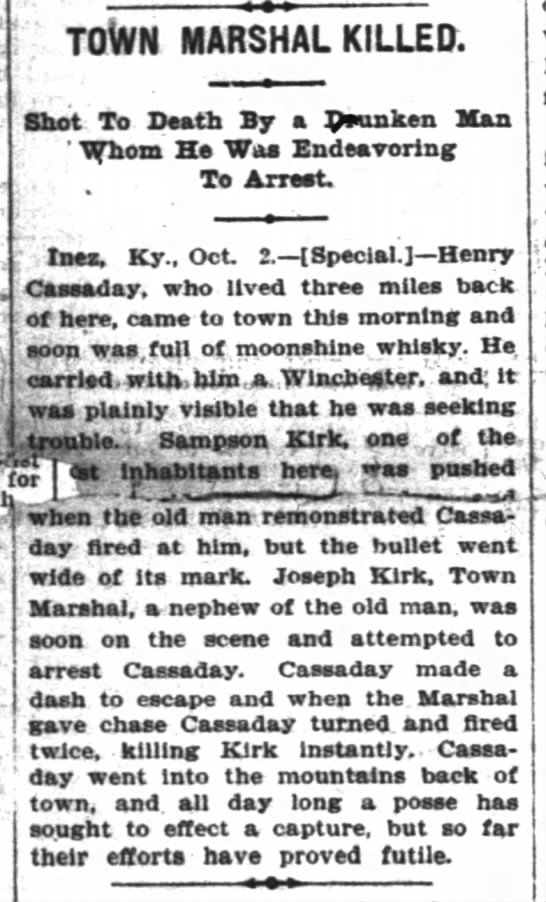
 Numerous newspapers reported that, on the day before, Henry Cassady had come to town and soon became intoxicated on moonshine. The Courier-Journal in Louisville, KY states that Cassady was looking for trouble. And in that search for trouble, he fired two unprovoked shots at Sampson Kirk. The bullets missed but the incident prompted Kirk to swear out a warrant against Cassady.  The warrant was given to Inez Town Marshal Joseph Kirk to serve.  Marshal Kirk was the nephew of victim Sampson Kirk.

clipped from the 
Louisville
Courier-Journal
October 3, 1899

Marshal Kirk rode out to the home of Henry Cassady to serve the warrants, but Cassady was not home.  However on the way back into town, Marshal Kirk met Cassady.  When he ordered Cassady under arrest, Cassady raised his Winchester rifle and shot Kirk two to three times, killing him instantly.

However, other sources report that Cassady and Kirk met up and an old political grudge started a quarrel between the two men. And as a result, Cassady shot and killed Kirk.

And yet another edition the Louisville Courier-Journal, dated December 4, 1901 stated that the murder was the result of a dispute over the mortgage on a yoke of oxen belonging to Cassady, which Kirk tried to foreclose.

And yet another source, my 11th Grade English teacher who has ancestral connections to the Cassady’s,  said that her family told her that Inez had just installed some wooden sidewalks.  And a cow belonging to Cassady had gotten out and was destroying the sidewalks. And Kirk was trying to arrest Cassady for it.  And it resulted in Cassady killing Kirk. 

Regardless of which version is the correct story, Kirk was dead and Cassady immediately fled to the mountains.  A posse was formed to search for him. Since it was believed that he had fled to West Virginia, Huntington, WV detectives were also brought in on the search. A $400 reward was offered for his capture.

Nearly two years later, on May 19, 1901, United States Marshal Cunningham returned from Clay County, West Virginia, where he had arrested Cassady near Sycamore Creek. 

Cassady confessed to the crime and then telegraphed Gov. Beckham for protection upon his return home.
Clipped from the 
Courier-Journal
May 20, 1901


Cassady was returned home to Inez, KY, the county seat of Martin County, where the trial was scheduled to begin on May 30, 1901.

Due to so much conflicting information, I’ve omitted the trial delays. I tried to sort out the facts, but it was just too confusing and unclear. So I deleted all of that.   But the trial was delayed more than once.  Finally on December 2, 1901 the trial got underway. Special Judge Segraves presided over the trial.

Clipped from 
the
Courier-Journal
Dec. 4, 1901


The details of the trial are not known, but Cassady was found guilty and was sentenced to two years in prison. (Two years seemed to be the normal sentence for murder back in the day.  A lot of the murder cases I have researched have all lead to just two year sentences.)  Cassady was given a stay of judgment for sixty days pending an appeal and was lodged in the Catlettsburg, KY jail for safekeeping during that time.  I’m assuming the appeal failed because he was in fact sentenced to the two years.

 Cassady’s trial ended up costing the state $3500.00.


 In January, 1902, according to the Louisville
Courier Journal, A petition for a pardon was circulated in Martin County. Over 700 of the 900 voters in the county signed the petition. 
clipped from the
Courier-Journal
January 18,1902


 And in October 1902, Cassady was pardoned by Governor Beckham.


clipped from the Mt. Sterling Advocate
October 8, 1902


Another strange case regarding the Cassadys:  The Courier Journal reported on January 17, 1902 that Henry’s siblings Amos and Lincoln mysteriously disappeared when they were 13 and 14 years old. They left home and were never seen or heard from again.  When their wealthy father passed away, the rest of the family attempted to find them but were unsuccessful.  But they were heirs to a fortune, according to the Courier-Journal. 


Thursday, October 6, 2022

The Murder That Could Have Started A Civil War


It was Saturday, July 20, 1912. And the Magoffin County, Kentucky area was reeling from the recent murder of Mack Bailey just days earlier on July 7th.   Little did they know that another murder was about to take place in their county, one that had officials concerned that it could erupt in an all out county civil war.

This particular Saturday, a fight broke out between Lee Patrick, brother of U.S. Marshal Asberry Patrick, and Ern and Clarence Arnett.  The Arnett’s and the Patricks were two very prominent families in the Magoffin County area at the time, and still are to this day. The Big Sandy News in Louisa, Kentucky reported on July 26, 1912 that young Clarence Arnett stabbed Patrick with a butcher knife, killing him instantly.

Historic Downtown Salyersville 

According to the Salyersville Kentucky Mountaineer, dated July 26, 1912, Lee Patrick’s wife, who was a sister of Role Minix, had left Patrick a year or so prior.  Arr Arnett, Role Minix’s father-in-law was the attorney for Patrick’s former wife.  A deal had been reached wherein Patrick was to pay $200.00.  He borrowed the money and came to town to settle the matter, only for Arr to tell him that he must pay an additional sum of $25.00 to his son Ern for services.  Patrick refused to do so.  And as a result, the trouble started.
 
The statements about the case were somewhat conflicting according to the Salyersville Kentucky Mountaineer.  The defense introduced no proof.   But the prosecution presented 12 witnesses.  These are their statements:

“ Some three or four months ago, I was in the law office of Arnett & Howard, and Lee Patrick was there.  They had met there for the purpose of taking depositions in the case of Lee Patrick and his wife.  Arr and Lee were talking about the case and some few words were spoken when Arr grabbed up a whet rock or weight and drew it on Lee.  I thought they were going to kill him and I had to jump up and tell them that they couldn’t all jump on him.” – Jack Minix

“On the day of the killing Mitchell Whitaker and myself were on the walk just in front of the Adams pool room.  Ern Arnett came out and said to Lee Patrick ‘come out in the street and fight me.’  Lee had not said anything to him before Ern ran out and bantered Lee.  Patrick was across the street near the curbing and he came into the street and Ern and him got within a few feet of each other.  Ern was keeping his arms going.  I couldn’t tell just where his arms were all the time.  When they got over near the pool room, Ern jumped in the pool room and Lee just afterwards.  Minix was just behind Clarence on the walk.  After t hey got in Clarence came out fast just in a second.  As Ern and them came out and Arr was there. I heard some one say don’t go in.  It’s already done.  Lee went over toward Ern like he was laughing.  I didn’t think they were going to fight.  Lee could have shot him.  Had all the chance that was necessary.” – Wiley Caldwell

“I was in the Minix pool room when Arr and Lee Patrick were having their racket.  I came out. Lee was leaving and I heard him say that was jumping on him for nothing.  After the killing or about the time of it, I saw Roll Minix coming from Adams pool room door.  He was on the walk near the stove.  He had a pistol and ran into his grocery”. – Bascom Prater

“I was on the walk in front of Minix grocery and the first thing I heard or saw was some people going in the pool room. I couldn’t tell who went in first.  I saw Roll Minix come running out of his store with a pistol and heard a woman tell him to shoot him.  I saw Clarence Arnett come out of the pool room.  I went up and looked in.  A crowd was in there.  I then got on a horse and started after Jack Patrick.  Just across the bridge I met Maurice Minix coming with a gun, and on the walk I saw a man just above there hide a gun under the walk at John Hale’s and he asked me if Lee Patrick was killed.” – Bill McPherson.

“I was in the Minix grocery a short time before the killing.  Andy Meade and myself.  We were back by the lemonade stand.  There was some excitement out in the street.  Roll Minix seemed to be excited and called to Clarence Arnett to come there quick.  Clarence and Roll whispered a minute and Clarence went in a fast walk back behind something in the store.  I heard a noise in there like he was turning over something.  Then he came out and he and Roll went out on the walk.  I then saw Clarence with a hammer.  This was just a short time before the killing.” – Billy Phipps.

“Saw Ern come out of the pool room after the killing and heard him say, ‘The damned son of a b—‘.” – Farish Lacey

“I was standing on the curbing near the bell tower.  The racket came up over about the pool room.  I looked and saw Roll Minix come out of his grocery with a pistol and a woman hollowing ‘shoot him, Roll, shoot him.’” – Virgil Patrick

“I was in the pool room when the racket came up.  I was engaged in the game.  My attention was first attracted by hearing talking on the outside.  I looked and saw Ern Arnett come out in the street and hollow something to Lee, who was across the street.  Lee said something that I did not understand.  They then started out and were meeting each other.  I saw Lee like he was pulling up his sleeves.  When they got near the door Ern jumped up in the door and around by the side of the cashier.  Lee put his hand back like he had a pistol and jumped in the door.  I jumped out the window and ran around to the back door and looked in and saw J.L. Arnett pulling Ern off Lee.” – George Anderson

“I was on the walk near the upper window of the pool room.  Ern Arnett came out of the Minix Grocery and out in the street.  The first thing I heard was Ern said to Lee, ‘G—D--- you, I can whip you.  Lee started across the street walking along and they got close together, and I saw Ern back a shot distance and Lee had his hand like he had a pistol.  Ern jumped up in the door and Lee just behind him.  I thought I would grab Lee but I saw Roll Minix and Arr Arnett coming up and I thought I had better not interfere in their racket.  I don’t know that I saw Clarence go in.  I saw someone, some small fellow run in after Lee.  I saw Clarence come out just after the killing. When I saw Minix, he had something. I took it to be a pistol.” – Dud Howington

“About fifteen minutes before the racket in which the killing occurred I heard Arnett and Lee Patrick having some words.  I heard Arr call him a rascal and a dog and several vile names.  Lee said ‘that is all right what you say just so you keep your hands off of me.’” – J. Press Adams.

“I heard a woman scream across the street and I saw Ern Arnett and Lee Patrick in front of the pool room, Ern over next to the pool room.  Lee had his hand back like he was going to pull a pistol.  Ern said ‘don’t you do that, and Florence Minix said ‘shoot him’, ‘kill him’, or words to that effect. Ern was in the pool room and Lee was going in  at the door when Clarence Arnett ran up and caught him with one hand and I took it to be a small sized butcher knife in his hand. They then disasppeared in the pool room.” – J.B. Bailey

“I was in the pool room and the first thing I saw was Lee Patrick in the door, or just inside, and Clarence Arnett just behind him.  They were in kind of a tussle.  About that time Ern Arnett closed him and had his arms around Lee and Clarence ran up and made a lick and run.  Ern and Lee then went down on the floor and Ern was on top and Ern was striking him with his fist.  While they were on the floor standing I heard Lee groan or make a  noise like a sick person, then they went down and I heard him groan twice more while Ern was  on him.” – Frank Anderson

“I was in the Adams pool room.  I heard some loud talking on the outside and recognized Ern Arnett’s voice.  I heard him invite Lee Patrick to fight him.  Lee said something and laughed.   Ern started at him and got within a few feet of Lee and Lee put his hand back like he had a pistol.  They got near the pool room door and Ern got up in the door and got over next to the counter on the right side.  Lee then came up in the door and Clarence after him.  As soon as Lee entered the room, Ern closed him and had around his arms and Clarence ran in while Ern was holding him and stabbed him in the breast with a large knife.  Lee then sunk down or he and Ern fell on the floor and Ern commenced to strike him in the face with his fist.  A short time before the killing my brother,  Will Crace, and me come down the walk near  the pool room.  Lee Patrick and Arr Arnett were having some words.  I heard Lee say, ‘Arr you got mad at me for nothing. Go on, I don’t want any trouble with you.’ “ – Jim Crace

Within a few minutes Deputy Sheriff Jackson L. Arnett arrested Ern Arnett, Arr Arnett, Clarence Arnett, Arby Arnett, and Roll Minix and put them in jail.

As word of the killing spread through the community, the talk of more violence began to fill the streets. Due to the prominence of both families, it was feared that the trouble would erupt into an all out county civil war.   This prompted Judge Gardner to place the state guards around the jail on Saturday and they remained there until Tuesday.  

Judge Salyer set Clarence Arnett’s bond at $3,000 and Ern Arnett’s bond at $2,500.00. He acquitted Arr Arnett and Roll Minix.  The Arnett’s bond was filled and they were again at  large.
 
Lee Patrick became the sixth man to be murdered in Magoffin County in a 12 month period. The other five were Leck Whitt, Buddy Whitt, James Harper, Samuel P’Simer, and Mack Bailey.  And according to the Hazel Green Herald, as reported by the Salyersville Kentucky Mountaineer dated August 2, 1912, it was a brutal one.    The Herald allegedly reported that the Arnetts held Patrick and “literally cut his body to pieces”. It went on to say that they severed his heart. 

The exact dates vary per source, but sometime in September 1912, Ern Arnett, Clarence Arnett, and R.C. Minix were indicted for the murder of Patrick.  They tried for bail and the Arnetts were granted bail of $5,000 each and Minix was granted bail of $2,500.   The Commonwealth requested a change of venue, and it was granted.  The trial was moved to Mt. Sterling, KY (Montgomery County) and it was scheduled to get underway in January 1913.

January rolled around and the trial was postponed until the April 1913 term of the court due to the defense not being ready for trial.  According to the Courier-Journal in Louisville, KY (January 24, 1913 edition), 25 witnesses were called for the defense and 35 witnesses for the Commonwealth.  Witness claims aggregated a cost of $1,024.  It was predicted at the time that the trial would cost the state $5,000.00.

On April 15, 1913 the trial of Clarence Arnett began in Mt. Sterling, KY. By this time the witness count had climbed to more than 100 people.   Clarence was charged with conspiring with his brother Ern and R.C. Minix to kill Lee Patrick.

 According to the Louisville Courier-Journal, dated April 16, 1913, Jury members chosen to hear the trial were B.F.Perry, Harry Campbell, A.B. Oldham, R.E. Tipton, James Leach, Lester Lee, W.E. Sledd, James Montjoy, Charles Fogg, R.C. Robinson, Elson Wills, and Ewell Payne.

The defense was represented by William A. Young of Morehead, KY, Floyd Byrd of Lexington, KY, Judge E.C. O’Rear of Frankfort, Henry R. Prewit and C.W. Nesbitt of Mt. Sterling.  The Commonwealth Attorney W.B. White was assisted by County Attorney E.W. Senff, R.A. Chiles, and United States District Attorney Edward P. Morrow of Covington,KY.

Three days later on April 18, 1913, Clarence was acquitted by the jury after just 30 minutes of deliberation.

The trial of Ernest “Ern” Arnett was scheduled to begin a year later on April 16, 1914.  However due to the absence of witnesses and of prosecutor Edward P. Morrow, it was moved to September of that year.
And on September 24, 1914, Ern too was acquitted.

All efforts to find the outcome of the trial of R.C. Minix were unsuccessful.

Lee was laid to rest in the Francis Patrick Cemetery.

Augustus “Ar” Arnett died in 1922, his son Ern died in 1942, and Clarence died in 1970.

This brought about the end of another sad chapter in Magoffin County’s history.


Sunday, September 11, 2022

The Chain of Murder: The Murder of Dave Wireman & The Events Leading Up To It


The summer of 1931 brings us back to Magoffin County, Kentucky, the scene of yet another murder.

When the news first broke, the reports stated that two men and two women were gunned down as they worked in the fields.  However investigators would learn that was not the case at all.  But let’s start from the beginning.

In 1929, Frank Johnson was charged with the murder of Frank Shepherd in Floyd County, KY.  And allegedly, he was also suspected in the robbery and murder of Nelson Hale in Magoffin County, KY that same year.  And he was wanted for a number of other robberies in the area. However, I was unable to find any details on either of the two murders.  But because of these murders, Mr. Johnson was on the run and had been wanted for more than two years.

On June 2, 1931, a posse lead by Floyd Wireman set out in search of Frank. When they found him, a shootout erupted and Frank Johnson was killed along with posse member Brack Pinks.   It was believed that Robert Johnson, brother of Frank, was wounded in the shootout but he managed to escape.

Dave Wireman, 
courtesy of Find-a-Grave

The next week, Dave Wireman was working in the fields when he was ambushed and shot.  Initial reports stated that four members of the Wireman family had been shot, but that proved to be untrue.

The Louisville Courier-Journal reported on June 11, 1931 that Wireman and his 7 year old son James were in the field working when the ambush occurred.  The shot, which came from a brush pile, came from a revolver. The bullet entered Wireman’s left chest. He died instantly, according to a report published on June 10, 1931 in the Kentucky Post and Times-Star in Covington, KY.  A second shot whizzed by James. James jumped into a creek and took cover.  After the threat had passed, he ran home and reported what had happened.

Police believe that Robert Johnson was responsible for the murder of Wireman, in revenge for the slaying of his brother Frank a week prior. Mr. Wireman and his son Floyd both had been a part of the posse that had killed Frank.

Immediately after the murder of Wireman, bloodhounds were brought in from Lexington to assist a posse in their search for Johnson.  Here is a report, copied and pasted directly from the Lexington Herald, Lexington, KY, July 12, 1931, in reference to the hunt. Oddly, it was the only article that I found that stated another reason for the killing:

“A thrilling chase of an outlaw-killer through  the mountainous country of Magoffin county was told by W R Sebree,  who returned to Lexington yesterday after having taken his bloodhounds 20 miles east Of Salyersvllle in an effort to capture the murderer  of Dave Wireman,  who was killed from ambush at Ordway Tuesday. 

According to Mr. Sebree, his hounds took up the trail of the murderer from the scene of the killing In a field where Wireman and his 14-year-old son, Jimmie Wireman, were working and followed the fugitive to a mountain around which a posse of approximately 300 men is now stationed awaiting the appearance of the killer.

 Mr. Sebree said that Robert Johnson, 28 years old, is accused of the killing and Sheriff Adam Carpenter, of Magoffin County, had ordered the posse to shoot to kill if he made his appearance on the mountain.

Wireman, who was postmaster at Ordway, is said to have gained the enmity of Johnson when he testified against him in a liquor case. Following the shooting Tuesday, a note was found on a tree near the scene of the murder in which the writer stated that he intended to kill three other persons.

 The murderer of Wireman also fired several shots at Jimmie Wireman when he attempted to reach his father after he had fallen. Panic stricken, the boy ran to his home and notified other members of the family of the shooting.   Fearing that others might be killed, no attempt was made to get the body of the elder Wireman until a posse had been formed several hours later.

During the man hunt which was carried out all day Wednesday,  Mr. Sebree said that several times the hounds were so close upon the fugitive that his footstep could be heard, but that they could not reach him because of the thick mountain undergrowth.”

And sadly, this is where the story ends.  I searched extensively trying to find out if Johnson was ever caught and brought to justice.  But just as the posse’s efforts were in vain, so were mine.

I want to thank Sharon Wireman Holiday for making me aware of this case.  I hope my research, as brief as the findings are, filled in some of the blanks for you and your family.


Saturday, September 10, 2022

Charles Manson: His Kentucky Roots Run Deep!


Charles Manson

I normally don’t do two blogs in one day.  And I do have a more serious case to investigate for a blog that I will be starting soon.  But this subject once again came up on a social media group earlier this week.  And as always it was full of mistruths and rumors.  So I thought that I would do a short blog to hopefully once and for all shed some light on Charles Manson and his Kentucky ties.

Last year I learned that Manson was my 9th cousin once removed. Though very distant, when I found there was a little bit of an ancestral connection I began digging into Manson’s Kentucky beginnings.

I am eliminating names here because I don’t want folks going around  vandalizing graves simply because someone was related to Manson.  And yes there are idiots out there that would do that.

 But Charles Manson, for all intents and purposes, was a Kentucky boy. He spent time here, and his roots run deep here.

Charles was born in Cincinnati, Ohio.  His mother was born in Rowan County (Morehead), KY.   Her parents resided in Rowan County before eventually migrating to Ashland, KY. In fact Charles’ maternal grandmother was born in Rowan County as well, and his maternal grandfather was born in Elliott County, KY.

One of the homes in Ashland, KY
where Charles lived for a while.

I don't have a timeline of when they actually moved from Morehead. But I know they lived for a while in the Grahn community in Carter County. And according to Ron Daley of the "Troublesome Creek Times" in Hindman, the family arrived in Ashland when Charles' mother was ten years old. Her parents stayed there and apparently died there because that is where they are buried. 


 Charles Manson's Maternal Great Grandparents, Great-Great Grandparents, and Great Great Great Grandparents were from Carter County, KY and are buried there. His 4th Great Grandfather was born in Richmond, KY and is buried in Carter County.


The Home of
Charles Manson's Father
that used to stand in
Catlettsburg, KY

Manson's biological father was born in Pike County, KY and resided and  is buried in Catlettsburg, KY in Boyd County.  Manson's Paternal Grandfather is from Pike County, KY and is buried in Catlettsburg Cemetery as well along with his wife.


Manson's paternal Great-Grandparents and Great-Great Grandparents are buried in Pike County, KY.


Author Willie Davis stated in his book “Ghost Towns of 174” that Manson recounted in a San Quentin video about spending time in Morehead just before heading to the West Coast.  Charles also said in a letter to Ron Daley "I stomped all over Ky."


The former Blue Moon Cafe
Knott County, KY. Charles & his mother
lived upstairs for a short time.


 For a brief period of time, Charles & his mother lived in Knott County, KY where she worked at the Blue Moon Cafe. She worked downstairs in the bar - and they lived upstairs. Charles said that he was 5 or 6 years old at the time.  
Charles went on to describe Hindman as a "law and order border town," and said that "it's true that you can't take the hills out of the boy." That building, though rapidly falling into despair thanks to vandalism after Charlie’s passing, is for sale.


 In closing I want to clear up on rumor that I have heard time and time again.  And that is the rumor that Manson and his family killed his Uncle in Ashland, Kentucky.  That is not true.  Yes, he was a suspect for a brief time.  But the Los Angeles Police Department was able to prove that Manson was NOT in Kentucky at the time of his uncle’s murder.


So I hope this clears up some misconceptions and rumors about Manson’s Kentucky roots.

Forgotten Kentucky: The Day a Fighter Plane Chased a UFO Over Fort Knox

  Courtesy of The Morehead Minute Newsletter: By Joe Clark For The Morehead Minute Long before The X-Files , before Project Blue Book becam...