Tuesday, September 12, 2023

The Most Violent Domestic Murder Case In Kentucky History


A few days ago, I was browsing YouTube when I ran across a video by The Hillbilly Files-Legends and Locations entitled "1946 Kentucky Murder Rampage-Finding Anderson Adkins"


The title alone piqued my interest, so I watched the video.  The video described what would be known as "the most violent domestic murder case in Kentucky's history."


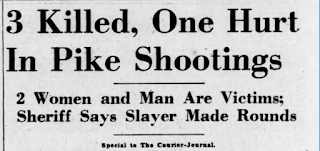
The Courier Journal, Louisville, KY
February 12, 1945


Anderson Adkins was born November 13, 1911 in Pike County, Kentucky. He was  the son of Haze Hayse Adkins and Martha Justice Adkins.


Little is known about Adkins' childhood and upbringing. According to court documents, he married  Elmo Bentley in 1933.  And together they had a child, Jimmy Donald Adkins. They resided in the Marrowbone community in Pike County near their relatives.


In 1942, Adkins and his family moved to Baltimore, Maryland where he worked  in a ship building plant. They returned to Pike County, Kentucky in either the winter of 1943 or early spring of 1944.


At some point the couple began to have marital problems. And in April 1944, Elmo files for divorce.  and for custody of Jimmy. While the divorce suit was pending she goes to Fairfield, Ohio to work in a defense plant. She left Jimmy with her parents, Alexander Fayette Bentley and Belle Coleman Bentley.


Sometime later the divorce was granted to Mrs. Adkins and she was given custody of Jimmy.  However Anderson was given permission to see his child  at least once a week. Anderson would go to the Bentley home, pick up Jimmy, spend the day with him before returning him on Sunday.

Anderson Adkins - photo
on his grave headstone


On February 10, 1945, Anderson goes to pick up Jimmy, but for unknown reasons (at least unknown to me)  the Bentley's refuse to let Jimmy go with Anderson. 


The next afternoon he went to a filling station owned by Orbin and Verna Bentley Long.  Verna was a sister to Anderson's ex-wife Elmo.  There, he purchases some gasoline. Before leaving he tried to persuade Verna to write a letter to her sister Elmo to encourage her to give custody of Jimmy to him. Verna refused stating "I will write her no letter and if I can do anything to prevent it, you won't be seeing Jimmy or Elmo either again." From this point on, Anderson claims that he remembers nothing until he was arrested a few hours later.


Evidence was presented by the Commonwealth proving that Adkins did in fact purchase the gas from Verna. And as she was standing beside his car conversing with him, he drew a pistol and shot her.  She ran toward the rear of the car. Adkins exits the car and continued to fire his gun.  In the meantime an automobile had driven up and stopped just behind Adkins' car.  The car, occupied by Mr. & Mrs. Bryce Childers and their small daughter.  One of the bullets fired by Anderson passed through the windshield of the Childers' car and struck the little girl.


Mr. & Mrs. Earl Johnson were passing the gas station in their truck as the shooting was occurring. They saw Adkins shoot Verna. Verna fell to the pavement. Adkins walked up to her body and struck her with his gun.  He then reloaded the gun, got in his car, and drove to the home of Bill Goff about 1/2 mile away.


Adkins walks to the door of the Goff home with his pistol in hand. Mrs. Goff opened the door. Adkins asked for her husband and was told that Mr. Goff had gone up the road. However Mr. Goff was in the house listening to the radio. Adkins responded to Mrs. Goff "I hope I meet him; I will get him and I will get old Fayette", meaning Fayette Bentley, the father of his ex-wife.


Adkins confessed to Mrs. Goff that he had killed Verna Long.  There was proof that he also had attempted to shoot Goff a few weeks before, and there was evidence to convince the jury that he was angry at Goff because he believed Goff had some part in Adkins' separation from his wife.


Adkins leaves the Goff residence and drives back  in the direction of the gas station where the body of Verna was still lying in the road.  As he approached the home of Mr. & Mrs. Tom Johnson, which was located almost straight across the road from the gas station, he applied his brakes. Due to the high rate of speed that he was driving, the car swerved, went over an embankment and stopped in a ditch.


The Johnsons and their son-in-law, Ed Burgess, had heard the shooting and had  gone out to see what had happened. When Adkins ran into the ditch, they started back toward their house. Mr. Johnson went around the house. Adkins followed with pistol in hand and overtook Mrs. Johnson just as she reached  the front steps.


Mrs. Johnson said "Anderson, I have never harmed you, what are you coming up here for?"  Adkins replied, "Oh yes you have, I have come to get you," and immediately started firing. Another witness testified that Anderson responded to Mrs. Johnson, "damn you I am going to get even with you." 


Three bullets struck Mrs. Johnson - one in the breast, one in the back, and one near her right eye. She died instantly.


This same day, Attorney A.E. Auxier and his wife were driving from Pikeville to Elkhorn City. They reached the Long gas station just after the shooting of Mrs. Johnson. He saw the body of a woman lying in the road. He drove his car onto the berm of the road and stopped.


Mr. Auxier observed a car in the ditch a short distance down the road and saw Adkins across the road from the ditched car loading his pistol.  Adkins then approached the Auxier car and said "I have to have this car."  The Auxiers got out of the car. Adkins told them to stand back. He then got into the car, said "I will do the driving" and drove off.


Adkins was next seen on Harless Creek where he drives to the home of Mr. and Mrs. Burton Bentley, brother of Adkins' ex-wife Elmo. Burton was not at home but his wife Thelma and their baby were.  Adkins rushed into the house with gun in hand, and, when told that Burton was not at home, said "I will let him do a little suffering, he is not here."  


Adkins then opened fire on Mrs. Bentley, shooting her in the breast. She ran into the next room where her baby was in a crib.  Adkins shot her a second time, striking her in the arm. She sinks to the floor. Adkins shot her again, this time in the head. He then kicked her three times and then left.  Mrs. Bentley recovered but was totally blind from the shot to the head.


Adkins then drove to the home of Clarence & Mella Bentley Blackburn. Mella was a sister to Adkins' ex-wife Elmo.  Adkins opened their door and walked into the dining room where the Blackburns were sitting at the dinner table.  Mrs. Blackburn testified that Adkins came in with his hand in his right pocket. and said "I have come after you and your mother both. What have you to say?" He walked around and put his pistol to Mella's back. Clarence knocked the gun down. Adkins then shot Clarence once in the chest. He raised the gun at him again. Clarence responded "Anderson, don't do that, you have shot me through."  Adkins shot Clarence again in the chest.


Mella jumped between them and a struggle between the three of them began. Finally, Clarence got the gun. He ran toward the door with it. He  then threw the gun into the creek and then collapsed and died.  Clarence died within thirty minutes of being shot.


Adkins left the Blackburn home. Before he reached the main highway, he overtook a  truck which had  stalled and blocked the road.  The truck belonged to Shannon Sawyers, who testified that Adkins was driving pretty fast. Sawyers testified that he went to see what the trouble was that they couldn't let Adkins by. At this time Adkins was standing near the back of the truck that was broke down. Adkins said "for mercy's sake, unblock me, I'm in a hurry, I want to get by." Adkins then said "they will follow me."  Adkins then helped them push the truck out of the way.


Adkins  then drove back down the main highway past the Long gas station and onto the Lavisa Fork of the Big Sandy River. A truck occupied by Scott Blackburn and his wife overtook Adkins. Adkins asked Blackburn to take him to Hayes Justice's store which was located at the foot of the mountain about 400 yards up the road.  Hayes Justice was Adkins' cousin.


While in the truck, Adkins told the Blackburns that he had just killed four people - Orbin Long's wife, a Johnson woman, a Blackburn, and a Bentley.


Adkins got out of the truck and went into the store where he had a short conversation with his cousin Hayes Justice.  He left the store and started up  the mountain toward the Virginia state line.


Two highway patrolmen, Tony Robinette and T.S. Saulisbury arrived a few minutes later and gave chase to Adkins. They overtook him about three miles from the store.  He started to run but Robinette fired several shots from his pistol and Adkins then surrendered to the officers. 


Adkins told the officers that he had killed four or five people and begged the officers to shoot him and leave him in the mountains.  As they were coming off the hill the officers asked Anderson if he realized what he had done and he said yes, that he had killed four or five people and that would be a lesson to them to keep their bills out of his business. 


With Adkins in custody, on February 12, 1945 Circuit Judge R. Monroe Fields ordered the Pike County Circuit Grand Jury to reconvene the next day to consider charges against him.


On Thursday, February 15, 1945 indicted Adkins on three counts of murder and two indictments  of malicious shooting. He was also indicted on a charge of armed robbery in the theft of the car.  He was held in the Pike County jail without bond pending his arraignment that was scheduled for the following week.


On Friday, February 16, 1945, Adkins plead innocent of the charges and Circuit Judge R. Monroe Fields set the trial for February 28, 1945. Adkins requested a change of venue for the trial on the grounds that he could not get a fair trial. The Judge refused to grant that change of venue.


On March 1, 1945 Judge Fields moved the trial date to March 22. Adkins' attorney stated he needed more time to prepare for the trial.


A newly summoned panel of 200 jurors were to be ready for the trial. The jury ended up consisting of all males.


from the Courier-Journal
Louisville, KY
February 15, 1945

On the witness stand, Adkins declared that his mind had "snapped" prior to the slayings and said that he could recall nothing of the shootings. Defense attorney E.J. Picklesimer told the jury of family troubles prior to the slayings and that Adkins had been brooding because he believed that his in-laws were responsible for the break up of his marriage. 

Adkins professed his love for his ex-wife and broke down and wept as he told of unsuccessful efforts to get her to come back to him. and of his attempts to gain custody of his son Jimmy. Adkins said he blamed the Bentley family, his wife's relatives, for her refusal to return to him.


Adkins related that on the night preceding the shootings, he had gone to the home of his mother-in-law with whom Jimmy had been living but had been denied permission to visit his son.  He stated that the next day he drove to see Mrs. Long (his ex-wife's sister) to ask her to write a letter to his wife.  She refused, after which, Adkins said, "My mind snapped and everything went blank."


The trial, which was for the murder of Adkins' sister-in-law Verna Long, ended with Adkins  being found guilty and sentenced to life in prison. Neither the defendant, nor his ex-wife showed any emotion as the verdict was read. Their son Jimmy showed little concern as well as he read a comic book during the proceedings. 


This was just the beginning of Adkins' legal troubles.  He still had other trials to go.  He would go on trial again  in May for the murder of  Mrs. Johnson. 


The jury was selected on May 22, 1945 and  the trial was scheduled to actually begin the following day.


During this  trial Adkins told the jury that shortly before the shootings that he had suffered a head injury at work at the shipyard in Baltimore. But during cross examination, Adkins admitted that he had lost no work due to injury.


For the murder of Mrs. Johnson, the jury deliberated less than two hours before convicting Adkins of first-degree murder and sentenced him to death. Just as in the first trial, neither Adkins or his ex-wife showed any emotion as the verdict and sentencing was read.


Judge Fields overruled a defense motion to set aside the verdict and  grant a new trial, and set the execution date for August 17, 1945 at Eddyville penitentiary.   The defense stated that the case would be appealed.


In November 1945, the Court of Appeals affirmed Adkins' death penalty.  Adkins refused to appeal the case again and the execution date was set for March 15, 1946. Governor Simeon Willis informed the counsel for the defendant that he would take no action.


In the early morning hours of March 15, 1946 Anderson Adkins was lead to the electric chair according to Warden Gug Tuggle.


Due to his execution, Adkins never stood trial for the remainder of the cases.


Adkins' ex-wife Elmo remarried , this time to Elwood Tomlinson. She passed away in 1994 and is buried in Marietta, Georgia.


As for Jimmy, well he went on to live a long life.  He married Ruby Ann Luster Adkins. He served in the Air Force and then his entire career was spent at Lockheed as an electronic technician. He passed away in 2018 and is buried in Marietta, Georgia.

Additional Information:  Much of this information came from the video "1946 Kentucky Murder Rampage-Finding Anderson Adkins."  AND from part of the court proceedings, found in the blog "Diggin'  Up Bones"


Sunday, September 10, 2023

Remembering A Kentucky Hero

This won't be a long blog. But I still wanted to  take the time to remember a Kentucky hero, Edward Thomas Earhart.


A native of Morehead, KY, Edward was born May 14, 1975 a son of the late Thomas Edward Earhart and Charlotte June Thomas Earhart, both of whom passed away in 2014.


Edward Thomas Earhart was the only military casualty from Kentucky to die in the September 11, 2001 terrorist attacks on the United States.


Petty Officer First Class Earhart was an aerographer’s mate in the U.S. Navy. He served on ships around the globe, helping vessels navigate around sea ice, before being stationed at the Pentagon. In his work, he forecasted weather for the Joint Chiefs of Staff, informing them of conditions for naval exercises which affect ships and air traffic involving aircraft carriers.


On September 11, 2001, Ed was scheduled to be on vacation but reported to work at the Pentagon to help a colleague. He was killed when a portion of the Pentagon was hit by one of the hijacked commercial jetliners used in the terrorist attack. Ed was 26 years old.


After his funeral, Ed’s coworkers signed a white U.S. Navy hat, commonly called a “Dixie cup,” and presented it to his family as a symbol of love and support. The hat is now on display at the 9/11 Memorial Museum.


Edward Thomas Earhart is buried in the Hamilton Cemetery in the Christy community of Rowan County, Kentucky. He is memorialized at the National 9/11 Pentagon Memorial in Arlington, Virginia.


Even though we were from the same town, I didn't know Edward. I knew some of his family though. And I'm forever grateful for his service and sacrifice to our nation.

(Bio courtesy of Sam Terry)

Wednesday, September 6, 2023

Floyd Williams: A True Story of The First Hanging in Wolfe County, Kentucky

 Of all the historical research I have done, and of all the blogs and books that I have written, I don't think one has ever affected me like the subject  matter of this one. 

As I was transcribing this article from the newspaper, for the first time ever I felt like I was telling the story through the eyes of the perpetrator.  And his story is very sad and unfortunate.  

On June 21, 1884 Floyd Williams of Wolfe County, Kentucky shot and killed Payton "Pate" Stricklin.

For this crime, Floyd was sentenced to hang.  Here is the newspaper report, diligently transcribed here:

"Floyd Williams Will Be Hung By The Neck Until Dead"

On Friday, July 3d for the Murder of W. Peyton Stricklin
 on the 21st Day of June, 1884


The trial of Floyd Williams, for the murder of Peyton Stricklin on the 21st of last June, occupied most of the term of the Wolfe circuit court last week, the case being called on Wednesday and concluded on Saturday morning with a verdict of guilty. The evidence of guilt, though only circumstantial, was very strong.


 Williams, who was in the employ of Stricklin, the evening before attended a shooting match at the blacksmith shop of George Miller, and while there had some words with Stricklin in regard to a settlement. Mr Miller acted as adjuster of the claim and the trouble was apparently settled, the understanding being that Williams owed Stricklin one and a half days work.  After the shooting match had ended Stricklin went off, and Williams lingered about the shop some time. While there he took a rifle gun, the property of Robt Lindon, who had left it with Miller to be repaired, and with which Williams had been shooting during the afternoon, and removed it to a corner of the shop.  The act excited no suspicion at the time, but the next morning, when the report went out that Stricklin had been shot from the bushes while plowing in his corn field, the people in the neighborhood turned out to find the murderer.  Geo Miller, upon going to his shop, missed the gun,j and remembering that he had seen Williams remove it the evening before, at once suspected him of the theft of it.


 Judge George Carson had been attracted to the house of the murdered man by the report of his death, and taking Emory James and Geo Miller, they went to where Stricklin had fell, looking for a clue to the murder. They found the bresh broken at a fence near by, where the murderer had concealed himself in wait for his victim, and looking about, discovered tracks. They followed these tracks, faint at first, until they were finally rewarded by finding a perfect impression of both shoes, upon which were patches.  They pursued the trail, which led to the house of Williams mother, and thence to Stricklins. There they found several persons gathered together, among them Floyd Williams.  Judge Carson stepped into the kitchen, where Williams was talking with the deceased man's wife, and remarked, "That was a bad affair Floyd; you and Pate had a quarrel yesterday evening."" Yes," Williams replied, "but it didn't amount to anything." Judge Carson replied "I think it amounted to a good deal; Pates killed." "Yes and I expect they will accuse me of it but all I want is a fair trial," replied Williams. Judge Carson had, in the meantime, looked at Williams' shoes, and discovered that they were patched to correspond with the tracks he had traced and measured. He therefore placed him (Williams) under arrest and started for Hazel Green.


 Geo Miller, in whose custody the gun had been, demanded it of Williams, and was told that he knew nothing of it. Bob Lindon, the owner of the gun, and the first one to arrive at the house after the murder, hearing that the gun was missing and what had happened at the shop the evening before, threatened to kill Williams, who, becoming alarmed, told someone to "Tell Bob Lindon if he will jist keep quiet he shall have his gun before twenty-four hours." 


Coming to Hazel Green the posse with Williams in charge met his mother, and he and his mother had some conversation. During this conversation, which none of them heard, Floyd was seen to motion with his hand.  Two men, Robt Rose and  H .C. Nickell, seeing him, concluded to watch his mother, and did so. She went in the direction indicated by her son and appeared to be hunting diligent for something.  She started away, hesitated, and again returned to hunt, but finally abandoned the search. Her watchers, however, took up the hunt close to the place where she abandoned it, and were rewarded by finding the gun, shot pouch and powder flask concealed by the side of a log under some leaves. As soon as it was known that the gun had been found, Williams' mother went to them and demanded it, but of course did not get it.  Williams subsequently asked one of the guards in charge, "If I should confess and prove threats from Stricklin, what difference would it make?" 


The foregoing was about the evidence elicited on his trial, and the jury in accordance with the testimony found him guilty and fixed his punishment at death.


 The prosecution was ably represented by Hon Wick Kendall, Col. L.M. Day, Ed. C. Orear, Esqr., and JB White, commonwealth's attorney pro tem. The defense had Judge Lykins, Judge Riddell, and Jos. C.  Lykins, Esqr., as representatives, who did all they could to save the prisoners life by lessening the penalty, while the lawyers for the prosecution did their best to hang him.


 It was the first prosecution Mr. Orear was ever engaged in, and old lawyers were heard to say that "it was a masterly effort."


Judge Cooper sentenced the prisoner to be hanged on Fridav the 3rd day of July next.  He was moved to tears in doing so, and convinced all that, though compelled to do so, it was a duty he reluctantly performed.


It is reported that Stricklin's wife has been indicted for complicity, and the opinion obtains that she is really the guiltier of the two, although the evidence before the jury in no way implicated her. Williams will be the first man ever hung in Wolfe County." 

- copied and transcribed from the Hazel Green Herald, Hazel Green, KY, May 6, 1885.


NOTE: Mrs. Stricklin was convicted in July 1885, and was sentenced to 99 years in prison.

clipped from the New York Times, July 21, 1885.


On June 29, 1885, Williams was granted a reprieve by the Governor, respiting him until Friday, September 4, 1885. 

On Wednesday, September 2, 1885, the Hazel Green Herald in Hazel Green, KY published Williams' death warrant. I've included that article here. 


On Friday, September 4, 1885, Floyd Williams was lead to the gallows.  I will once again let the Hazel Green Herald tell the story here:


FLOYD WILLIAMS PAYS THE PENALTY OF THE CRIME OF STRICKLINES MURDER

 By Death Upon The Gallows at Campton On Friday September 4th, 1885. His Confession Is Full

 Floyd Williams was hung at Campton on Friday last for the murder of Pate Stricklin on the 21st day of June 1885.  Sheriff Center and his guard arrived from Mt. Sterling just about dusk Thursday evening, bringing the condemned man, who has been in jail at that place since the death sentence was passed upon him. The people, many of whom were on hand to witness the execution next day, rushed to see him while the guard awaited the coming of Jailer Creech.  Only a few, however, succeeded in shaking hands with him before the jailer arrived, among them The Herald man, in reply to whose inquiry as to the prisoners health, Floyd replied that he felt as well as he ever did in his life, and he certainly looked the picture of health, while a smile played around his mouth.

 After supper we received a message from him, asking us to bring him a copy of his confession. One was taken him, and after reading it carefully he stated that it was correct. He asked for a cigar, and we handed him one, when he intimated that he was ready to be interviewed.  We asked him how he felt about the part he was to play in the drama next day, and he replied "Death can come only once to any man; I die tomorrow and another may die next day. The only difference is that one man may die in bed, another be shot, while I shall die upon the gallows." He said he felt as sure that he would pass into another and better world as he did that we were then reclining upon the mattress in the jail; that he had prayed to God as he best knew how, and that while upon his knees, and while  Rev. J.R. Deering, of Mt. Sterling, was praying with him in the jail at that place the night before, he had been pardoned of his sins.  He looked it. His face shone with gladness. He apparently looked forward to the coming day as one of much joy. He thanked us for The Herald, which we had sent him every week since he was captured at this place last spring.  After handing him some more cigars, we remarked that he would perhaps not feel like sleep, and the cigars would help console him. To our surprise, he replied that he would sleep as soundly that night as he ever had. We then, accompanied by Rev. W.L. Stamper withdrew, bidding him a pleasant night's rest. He thanked us and asked us to call again in the morning. He reminded Rev. Mr. Stamper that he wished to be baptized next morning at 9 o'clock. Thus we left him.  On Friday morning he ate very heartily of a choice breakfast furnished him by the jailer and spent some time in reading his testament. At about 9:30 o'clock A.M., Rev. W.L. Stamper had him taken to Swift's Camp Creek, and he there baptized him by immersion, while the crowd rendered appropriate vocal music. He was returned to the jail, and just before 1 o'clock the sheriff's guard formed, and he was brought out.

 The procession was headed by two guards, then came Sheriff Center, Floyd Williams, and  Rev. W.L. Stamper, who were immediately followed by Hon. J.M. Kash and Spencer Cooper of The Herald, then the main body of the sheriff's guard, commanded by Charley Cardwell and Buck Combs of Breathitt, marched in order and kept the immense throng from crowding the procession and the prisoner. When only a few steps from the jail, however, the mother and sister of the prisoner broke through the guard and fell upon his neck, at the same time giving vent to their grief in cries of distress and anguish. For a moment those nearest were paralyzed with surprise, but Sheriff Center quickly seeing the situation, feelingly called to the guard, and the two women were removed. The prisoner then turned partially around and handed a pocketknife through the guard line to someone, with the request that it be given to his father. Again he brought out of his pocket a small purse and a piece of plug tobacco, and handed them to someone. No other incident was noted until he passed into the enclosure which surrounded the gallows, about a quarter of a mile from the jail, when he mounted the steps two at a time leading to the platform upon which he was to make his farewell speech. A few persons whom he had chosen then took position with the sheriff and others on the rear end of the platform, and sung "Jesus Keep me Near the Cross," which he selected, and in the singing of which he joined. The hymn ended, Rev. W.L. Stamper offered up a prayer, and the sheriff immediately afterward informed the prisoner that he might speak to the people. Williams then walked to the corner of the scaffold and made a short speech to the crowd, about 4000 persons, requesting the people to abstain from the use of intoxicating drinks; to let cards and lewd women alone, and quit carrying pistols.  He reminded young men present that those were the principal causes of his trouble --of the death he was soon to die-- and begged them to let such things alone. He said he had been forgiven and hoped to meet them in heaven.  Asking their prayers, he bade them all farewell, turned and walked to where the sheriff stood, and told him he was ready. That official then began to adjust the noose about the prisoner’s neck, and many looked to see him break down; but in that they were disappointed.  He was as composed as though it were his happiest moment in life; not a muscle was seen to move; his countenance did not change.  Thus he appeared when the black cap was adjusted and his face was hid from view.  The Sheriff wishing him to step upon the trap, he moved up.  His arms were then tied and his legs pinioned.  All being ready, Sheriff Center at 22 minutes past 1 o'clock, stepped up to the lever, gave on look at the poor, doomed man, and exclaiming in a voice mixed with emotion, "Floyd, you must go; may God receive your soul," pulled the lever.  A crash of the falling trap was succeeded by the stillness of death-- all that was mortal of Floyd Williams hung suspended by a seven-eighth cotton rope just below the level of the scaffold, while the people breathed a prayer that his soul had found rest with the God who gave it .

The crowd quickly dispersed, and the physicians present, Drs.  J.H. Stamper and A. Congleton, of Campton; Drs. J.B. Taulbee, J.Mason Kash and F.M. Thomas, of Hazel Green; Dr. Moore of Frenchburg, and a Doctor from Stanton, pronounced life extinct at the expiration of 17 minutes.  The body was then cut down, and placed in a plain, neat coffin.  His neck was broken by the fall.  In compliance with the last wish of Williams, the Sheriff delivered his body to his father, Jeptha Williams, who had it buried on Holly on Saturday morning, a few friends being present at the obsequies. 

- copied and transcribed from the Hazel Green Herald, Hazel Green, KY, September 9, 1885.


At the very beginning I shared the newspaper article describing the crime and stating the verdict.  But there was so much more to the story, at least according to Floyd Williams.

It is not often that you get a genuine, truthful, confession from a perpetrator of a crime.  But having read his confession, I honestly believe that he was being very truthful.  And I believe that he was very remorseful and sorrowful for his crime.  His confession was very heartbreaking to read.  It was published as part of the same article as the above one:

HIS PICTURE AND CONFESSION 


Standing as I do, viewing the rapid and solemn approach of death, I feel it to be an imperative duty that I owe to God to make a full confession of the heinous crime I have committed. I realize fully that if any untrue statement wore to be made by me that God would bring me into account for it.  I make this confession knowing that Goi will not look upon sin with the least decree of allowance, the shadows of death falling upon me and the eternal rewards after death.
 
I was born and principally raised in Breathitt County, Ky.  I would be 22 years old on the 24th of July next.  My opportunities have been limited. I never went to school but three months. My parents did all they could to get me to go to school, church, etc., but all their entreaties were worthless upon me. I attribute my sad condition in a measure to disobedience to parents. Had I taken their advice, instead of being incarcerated in jail, I might have been as free as heaven’s pure atmosphere, or the limpid waters of my own native hills. When I was 9 years of age, family troubles caused me to leave the parental roof, arid go out into this cold-hearted world to do for myself. Unfortunately, being associated with boys of immoral habits, I formed a thirst for strong drink, and this thirst grew upon me until I became a drunkard.  But when under the influence of intoxicating liquors I was always harmless, feeling kindly towards all; and if previous troubles existed, when under the spell of intoxication, I always made it a point, if I had done wrong, to make reparation as far as possible. I would say to all young men “Shun the flowing bowl.”

 My employment has been principally that of a farmer. When in the employ of anyone, I always did what I could for their interest and satisfaction.  In the year 1882 my mother and I, together with two brothers and a sister, moved to Gillmore Creek, Wolfe County, and lived that year upon the farm of Joseph D. Graham.  During that time, I was unable to do anything scarcely, inasmuch as my dissipated habits had brought about a trouble that rendered me perfectly useless. In addition to disobedience to parents and drunkenness I formed an attachment for lewd and vile women, which precipitated me into a state that nerved me for the act for which I now languish. Had it not been for association with the lewd and vile, I today would be a free man. The next year, being 1883, my mother moved to Lacy Creek and lived upon the farm of John D. Rose. While there, I met for the first time with Mrs. Stricklin, at her house at a party, and owing to certain overtures from her, she and I became very intimate. This intimacy continued for about 8 months, during which time we were concocting plans by which we might get rid of Stricklin. Her first plan was to poison him, and ratsbane, as she supposed, was secured and put in his coffee, but it did not have the desired effect; so I am of the opinion that the stuff was not ratsbane, or if it was, that she failed to put in enough of it.

 She then proposed to make him drunk, and while in a state of intoxication, she would knock him in the head with an ax and then report that I had killed him in self- defense.  When she made this proposition, I told her that I would not have anything to do with a thing of that kind, feeling at that time that it would be wrong to take such undue advantage of anyone. After abandoning that plan, he came home one night while I was at his house and found me lying on his bed. He was very drunk, having been to Hazel Green, and rushing upon me, drew his revolver and snapped it twice while pointed at my breast. I then asked him what he meant, and he replied “I mean to kill you.”

 Mrs. Stricklin jumped up and pushed me out at the door saying “Leave or he will kill you.” She then said to me, “Where is your revolver?” I told her it was at my mother’s. If I had of had my revolver that night I would have killed him. I went to mother’s that night. After receiving such treatment at his hands, I was still not fully persuaded to kill him. Next day I hired to work for John D. Rose. About a week after that Pate came there and tried to get me to go and work for him. I told him I could not do it, for we could not get along together.  He went back home and sent his wife to see me. She asked me to come back and work for “Pate,” as she always called him, adding that she did not want me to go off. At that time, I was talking of leaving.  After listening for a time to her flattering words, I went back with her.

I then worked for him long enough to raise 400 bushels of coal.  We were to divide the coal equally. This he did not do, for I only got 10 cents worth of cartridges. He proposed that his wife should pay me for the coal in her accustomed way. Against this I entered my solemn protest. We then had another trouble at his house in which he threatened to kill me if I ever came inside his premises.

I left and went back to my mother’s and hired to work for John Rose again. I put up fencing for Mr. Rose, and one day while I was at work, Stricklin came to me and told me that he had done me wrong, and that he wanted me to come back and work for him.  I told him that it was useless to talk to me about it, for I was not going to work for him anymore.

He went back home and again sent his wife to see me.  I told her that “Pate” and I could not get along together, and if I went back he would kill me or I would kill him, and that I did not want to hurt him. She went back home, and the next evening he came again, and told me that he wanted to give me a chance to make something and would rent me a piece of ground.  My reply was:

“Pate, you and I have come very nearly killing each other two or three times, and I fear if I were to go to work for you that one or the other of us would be killed.”

But, after his repeatedly promising that he would do me right, I told him to go on home and I would come that evening and see him.  I went according to promise.  Pate seemed glad to see me, and he and his wife took me out and showed me the field that he proposed renting me.  While out in the field he asked me if I was not afraid of him, and I told him “only in one way,” that was that he would beat me out of something; and then he said if I feared anything of that kind, we would draw writings and let Rev. James Little hold them.  We did so. The day I went there I bought a hog from George Miller, and Pate was to furnish me corn to fatten it with, and I was to give him a day’s work for each bushel of corn I got. The hog was fattened according to agreement, and I killed it, but he took the meat and put it in the smokehouse and would not let me have any of it. We then had a few words, when we drew our revolvers, and had it not been for his wife and John Whisman, one or the other of us would have been killed.

I went and cleared off the ground, put it in corn and worked it over the first time, when he claimed that I had not cleared off the ground according to contract, telling me that I should not work any more at it.  This was the evening before I killed him. He and I went to George Miller’s blacksmith shop, and there we had another trouble. After the trouble had been settled he started home, and I told him “I would give him the corn to find him out.”

After he returned home his wife came to me while I was at George Miller’s sitting on the yard fence, and told me that Pate was aiming to kill me next morning.  I told her I guessed she was mistaken, and she replied that he said hie aimed to kill me if he lived. She then asked me if I was going to kill him, and I said to her, “Yes, I am.”  She then said “If you ever aim to do it now is the time, for he aims to kill you.” 

 I told her to go on back home, and that he would be killed sometime next day. I stayed at George Miller’s until about dark, and then I went down to the blacksmith shop, took the gun out through a crack, and taking it above Mr. Miller’s house, hid it in a fence corner.  I slept upstairs at George Miller’s house that night.  The next morning, while I was putting on my shoes, the clock struck 5. I went and got the gun and then went up the “Lige Branch,” as it is called, which heads up against the corn field where he was killed.  When I got about half way up the branch, fearing that the gun would not fire, I shot it off, the bullet penetrating a small beech tree that stood on the bank of the branch.  After firing the gun I found that I did not have any more bullets, and so I studied for quite a while how I should manage. I started back down the branch after debating the matter in my mind for a time. I then stopped, and putting my hand in the right hand pocket of my pants, I found a pistol ball that I had carried for some time. I put the ball in my mouth and chewed it until it was perfectly round, and then loaded my gun again. I then proceeded to the field where he was aiming to work that day and took my position in the corner of the fence and waited until he came up where his plow was. He hitched bis horse and put the line on his hand “clucked” to the horse, and then I fired the fatal shot that sent his soul into eternity, and for which I am to be hung on the 3d day of July. After I shot him I laid in the same place and same position about one half an hour. His wife and little girl were in about ten steps of him when I shot him.

 I then started in the direction of my mother’s, and when I reached the branch that I went up, I hid the gun behind a log. After reaching home I stayed there until about 9 o’clock, when I, together with John Rose, John Whisman, and my brother, went over to Stricklin’s house. There met my gaze the man that I had killed, and the feelings that came over me I cannot describe! When I stepped into the house there were 15 or 20 persons in the room, and they all gave me such a look that I was thoroughly convinced that they believed me to be guilty.  The reader has doubtless heard it said that “a guilty conscience needs no accuser.”  This I know to be true, from experience.  Being conscious of the magnitude of the crime I had committed, I believed that the people could read guilt upon my countenance.

Mrs. Stricklin then motioned me to come into the kitchen.  This I did. Then she told me to be careful how I talked; and giving me a bottle , she told me to go to Elsberry Little’s and get a quart of brandy.  I made a quick trip, and on my return, I was arrested and put under a guard consisting of seven men, Robert Rose, Henry Nickell, Fielden Cox, James Little, Robert Lindon, Henry Stamper, and Leander Brooks.

After we left Sricklin’s we went to George Miller’s shop, and Miller ran out with a large navy pistol cocked on me, and told me to tell where that gun was that I got out of the shop. My reply was that “I know nothing of the gun,” hoping, of course, to get out of the trouble I had gotten into.  The guard took the pistol from him and kept him from doing me any harm, for which I take this method of thanking them; but I must say that they did not treat me as a prisoner out to have been treated.  They tied me with a rope, put a chain around my leg, and fastened me to a bed-post, as though I was a ferocious animal, and not a human being.  This, added to the enormity of the crime that I had committed, made my condition a bad one.  But I forgive them all and hope they will never treat another prisoner as they treated me.

I had an examining trial and was held over without bond, whereupon I was taken to the Mt. Sterling jail, where I was penned up for ten long months.  The months seemed like years to me, and the mental torture that I had to undergo will take the arithmetic of eternity to tell.

During the ten months prior to my final trial Monteville Hatfield, William F. Caskey and myself concocted a plan by which we removed a solid stone in the wall, making a place sufficiently large, through which we passed out, and scaled the high wall surrounding the jail, and made good, as we supposed, our escape; but Hatfield and myself were recaptured and placed in jail again.

I want to return my thanks to Marshals Day and Punch and Mr. Watson for the kind and benevolent treatment I received at their hands.

 I was taken to Campton; had my final trial, and was sentenced to death. I was forced into trial without having two of my most important witnesses present. The sentence was a hard one, but I shall endeavor to bear up under it like a man. It looks hard for one to be cut off so early in life, from all its sweets and pleasures, but be it so. “God does all things well.”

The reader will observe the four downward steps in my short history: first, disobedience to parents; second, bad company; third, drunkenness, and fourth, a fondness for bad women. These, as a general thing, go together, and the result, if not exactly like mine, is always fearful. I trust my sad, and to me unfortunate fate, will be a warning to all young men. If I could but recall the past how different would my course be! But the die is cast and I am only waiting to be pushed off from friends and the associations of other days by a shameful death on the gallows. My father and mother gave me good advice, and they are in no way responsible for my conduct. I had a disposition to do as I pleased, which has brought others, together with myself, to a debauched and wretched end. O! that the innocence of childhood was again mine! When I think of the past, look to the future and see the gallows, and on beyond the of time and space to the Judgement, my heart bleeds within me , and I instinctively recoil, and would - were it possible- pray to be swept off by a decree of annihilation. But this cannot be. I must die, and then stand before the great Judge of the earth. O! my soul, be on thy guard and O! God, hear my prayer! I do not see how I am to meet my doom, notwithstanding I have become hardened by crime, and have in the past cared very little for anything. But let the stoutest heart see danger ahead, especially death, and it will, of necessity, be convulsed and tremble under the apprehension of danger. But I can say in the language of the sacred poet:

Show pity Lord, O! Lord forgive, 

Let a repenting rebel live;

Are not Thy mercies large and free,

May not a sinner trust in Thee?”

 I am not prepared to die: but I know God is a God of love, and not willing that any should perish but rather all would turn and live. I mean, God being my helper, to be prepared when the fearful crisis comes.

 Now, as the time of my execution is at hand, I say to all my friends “Farewell.” Soon this well wrought frame of mine must sleep in the cold embrace of death, and my spirit fly to other worlds. Oh God, may it rest in Thy bosom, secure from all the storms and persecutions of life. Shun as you would a deadly serpent, the past habits of my life, and let the little mound that shall sit quietly over my sleeping dust be a warning to you.

 To my father, mother, brothers and sisters: it breaks my heart to say that word that must separate us until the last loud trump shall sound.  – “Farewell.” God knows I love you and would love to live to enjoy your company, but the inevitable has come.  I am heartily sorry for bringing this sad disgrace upon you.  But my only hope is in God. Try to live in such a way as that we may meet in a better world than this. O! If I had died when I was young: then you could have pointed to the graces of my childhood its worthy of imitation.  If, after coming to the years of maturity, I had died in defense of the right, then you could have pointed to my death with hearts swelling with gratitude for my heroic valor. If I had died at my post of duty, doing what I could to make the world better by having lived in it, then you could have referred, with no small degree of pleasure, to my efforts.  But as it is I die all covered with shame and disgrace, and you can only refer to me as a murderer and having met one of the most shameful deaths known to the world. But will not God wipe out the dark spots on my character and “Make me whiter than snow,” and when I die take me to rest in the lap of Peace? Farewell! FAREWELL!

FLOYD WILLIAMS

- copied and transcribed from the Hazel Green Herald, Hazel Green, KY, September 9, 1885.


Sunday, August 27, 2023

"Bad Bill" Waters: The Scourge of Menifee County

 
I plan to do an in depth blog about "Bad Bill" Waters in the future. His story goes a little deeper than this article portrays.  But for now, here is this article that was written by Mary Lou Brown and published in the Courier-Journal, Louisville, KY, June 8, 1986.


"Bad Bill Waters

The Scourge of Menifee County 


His hot temper and violent, impulsive nature were nourished by a taste for the juice of mountain stills. But he always sounded calm and deliberate when he said, "I believe I'll just kill you."


By Mary Lou Brown


It was customary, he could have anything he wanted to eat, the warden told him, but the condemned man ate an unusually light last meal of fried oysters, sweet, milk, biscuits and coffee. Oysters a coveted food highly touted as an aphrodisiac, a rich man's food not readily available to a mountain man in the lean, hungry 1930s. Was the choice symbolic? He ate his oysters and spent his few remaining hours writing letters to friends and family.


At exactly 12:03 a.m. on Nov. 3, 1933, "Bad Bill" Waters, scourge of the Menifee County hills, stepped into the death chamber of the Kentucky State Penitentiary at Eddyville. Waters nodded to newsmen and to others gathered to witness his execution. No, he would have nothing more to say, except to deny that he had killed as many men as reputed.


He had said all he wanted to say in his appeal, which was denied. He acknowledged Floyd Willis, a Montgomery County farmer. "Well, Floyd, is this the first execution you've ever seen?" Willis nodded. Reporters later described Waters' tone as "bantering." The current was applied at 1 2:06 and "Bad Bill" Waters was pronounced dead at 12:09, ending a career of crime unparalleled in the history of Menifee, a Cumberland foothills county infamous in its early days for moonshine stills and a general climate of lawlessness. 


The road that Bill Waters traveled was a meandering trail of violence and murder leading from a small house on Hawkins' Branch, near Means, to the "big house" at Eddyville. Legend has it that Bill, "the meanest man in these parts," killed 13 men, but when pressed for specifics, old-timers will talk vaguely of "a man he killed over in Powell County" or of "two or three men he killed up in Ohio," supplying little or no evidence to support the legend. Jim Walters, 82, Bill's last remaining brother, states flatly that his brother did not kill 1 3 men. Jim long ago left Menifee for Grant County and is reluctant to talk about events of more than half a century ago, but he does so, he says, to "set the record straight" Jim is tall, as was his brother, straight as a yellow poplar, with a thatch of white hair and keen, blue eyes as perceptive as a hawk's. (Jim explains that the family name is actually "Walters," but through constant misspelling the "1" was finally dropped, reducing the name to He freely admits that his brother had a quick, murderous temper.


"Quick to get mad and quick to get over it He liked guns; always had a gun handy. That's what happened to the pack peddler," he said It has been rumored for 60 years that the itinerant peddler was Bill Waters' first murder victim. Bill, then 14, confessed the murder to Jim, but not to his parents, Polly and Ellis Waters. "A pack peddler came up Hawkins' Branch one day," said Jim. "You know how they used to walk the hollows with a pack on their backs, selling pots and pans, washboards, thimbles and thread? Our mother was at home alone.


The pack peddler got aggravated be-, cause she wouldn't buy anything. Talked right mean to her, she said, called her stingy. She wasn't She just didn't have any money." Bill came in from the field, and Polly told him about the rough manner of the peddler. Bill asked which way the peddler had gone, then slipped into a back bedroom and retrieved his shotgun. "He told me that he shot him, throwed him and his pack behind a log," Jim continued.


"A neighbor found the body, but the peddler was a stranger. Nobody asked any questions, and nobody ever came looking for him. That was the end of it for all I know." Jim describes his older brother as restless, searching always for adventure, excitement and money, which was rare on Hawkins' Branch. "He never was content to stay home and help Mother and Daddy, but he was a good worker. When just a boy, he bought two big goats and made him a can, harnessed his goats to it and went over to Powell County, where we used to live.


He hauled water for people in Clay City and made more money than my Daddy!" Bill then started going to Clay City at night, drinking and gambling. "It was more like home to Bill in Powell. That's where he got what little schooling he got" At an early age Bill tested for himself the potency of an illegal, home-distilled product made and sold locally in a Mason fruit jar. His fondness for drinking, fighting and gambling in Clay City did not go unnoticed. "First thing you know the law got an indictment for Billy, and he had to lay low for a while," said Jim.


"He was courting preacher Silas Amburgey's daughter, Bertha, and they got married. Then he joined the Army mostly to stay clear of the law in Powell County." World War I was in progress; the "long toms" were booming in France when the raw recruit arrived at Fort Knox for basic training. The restrictions of Army life palled on the impulsive mountain man, more accustomed to squirrel hunting in the early dawn than standing reveille. He simply walked away one morning, home to Menifee County. When the Army sought to reclaim him he turned himself in voluntarily, but in a few weeks he was home again.


Military police came for the recalcitrant soldier that time, but his third attempt at becoming a civilian succeeded. "Never knew if the Army turned him loose that last time or if he had deserted. He didn't say. Anyhow, nobody ever came after him," said Jim. Bill and Bertha settled down to serious housekeeping.


Four daughters Delma, Thelma, Hildreth and Gladys were born in quick succession. He found a job and seemed, on the surface, fairly content Other than his two vices, drinking and gambling, only one passion kept Bill away from home. When a baseball game was scheduled anywhere in the countryside, Bill was there. He was a pitcher, and a good one. When tempers flared on his favorite playing field at Chambers Station, Bill was known to walk away from the argument, holding his explosive temper in check.


But at home, he had no such control. With Bill away from home so much Bertha was lonely and "took to drinking," according to Jim. 


"Billy thought a lot of Bertha but couldn't get along with her after she started drinking. I kept him from killing her twee. She'd get drunk and just wander around, and it made him so mad he couldn't stand it.  Billy and I came in late one night, and Bertha was sitting on the side of the bed, drunk, with the little girls standing around. Billy was drunk, too. He said, 'Bertha, I believe I'll just kill you.'  He up and fired three shots at her with a .38 before I could stop him." Jim doesn't know to this day how he missed her.


"She never did raise her head up while he was shooting at her. I wrung the gun out of his hand, pushed him down on the bed and took his shoes off. He went to sleep." The next day Jim pointed out to his brother the bullet holes in the walls and in the ceiling. Bill said he remembered nothing of the incident, but Jim had his doubts.


 "Another time she was on the floor, drunk.  He said the same thing, 'Bertha, I believe I'll kill and leveled down on her with a Winchester shotgun. Again I ran under his gun, and he fired into the ceiling." 


Bill then moved to Ohio, a mecca of opportunity for a man wanting to work. But a state line did not cure what ailed Bill Waters: within a year he had shot and wounded a law officer who came to arrest him and was sentenced to a term in the Chillicothe Federal Reformatory. A short time later he and fellow inmate Ebra Thompson tunneled out of prison after first hiding in a drain pipe before lock-up.  The two men hid out by day and walked at night, heading for a refuge in the Kentucky hills that was always open to Bill: the home of Lulu and Taylor White on Science Ridge, a few miles from the Menifee County line, in Montgomery County.


 Lulu White, Taylor's 96-year-old widow, lives in Dayton, Ohio, with her daughter, Gertrude. Her ancient body is bowed by age, her red-rimmed eyes still bright with passion as she recalls the Chillicothe escape and the many "lies" told on her good friend, Billy. "That pore little feller had walked all the way from that prison," said Lulu. "His feet was a' bleedin' where he'd walked through the briars, him and that other feller.  Swum the Ohio River, he said. He said, 'Lulu, I don't want to bring no trouble down on and I got right down on my knees and I said, 'Billy, honey, you're not leaving here. You're staying. And if the law comes we'll fight it out with them right here on my front Would've, too," she added grimly. 


For the first few days the two escapees rarely left the confines of ." the White farm. But Thompson, a stranger to the area, soon became bored and began making daily trips to a general store, sitting and chatting with local denizens who loafed and whittled there. Bill thought Thompson was talking too much and to too many people. One day Bill invited the loquacious and unsuspecting Thompson for a little stroll in the woods. After a while Bill ordered Thompson to turn and face him. He pulled his gun and said casually, "I believe I'll just kill you." He aimed at Thompson's head, but Thompson ducked, instinctively shielding his face, and took the bullet in his arm.and asked Bill to take him to a doctor.

Thompson was bleeding badly. They walked back toward Lulu's, and by the time they reached the house Bill's anger had cooled. He agreed to let the man be taken to Mount Sterling to a doctor, which proved to be his undoing. 


The doctor immediately recognized the markings on Thompson's clothing as prison identification numbers. The two men were arrested and returned to Chillicothe. 


Bill had by now acquired a nickname that followed him to the end of his short life. "Bad Bill" a volatile man, eminently capable of murder, as explosive as kerosene on live coals; a man who would bear watching by friend and foe alike. 


When Bill was released from Chillicothe, he had no home to return to. Bertha, unable to cope after Bill was locked up, had put the four girls in an orphanage and had disappeared to make a new life. Bill went to Lulu's, his haven in any storm. 

 Lulu and her family were delighted to have him. "Billy was the most fun," said Lulu, and daughter Gertrude agrees. "We sang, laughed and talked," Gertrude recalls. "He played the French harp and the fiddle, and he'd take us to square dances and parties. We had an old 14-year-old dog that died of old age, and we took him up on the hill to bury him.We gave him a funeral, put flowers on the grave and cried over him you know how kids are." 


And Bill, not averse to killing another human being, cried over the dog's grave. He told the children that when he died he wanted his grave dug there beside the dog. "He said that we thought more of that dog than most people did of him. And he was buried there for 13-14 years, until his brother Jim had him dug up and moved to Williams' graveyard on Hawkins' Branch. He never wanted to be buried up there where so many people had been against him," said Gertrude.


Lulu also hastened to portray Bill as a kind, caring man, unaware of the inconsistency in her story: "I had an old cat, and little gang of chickens. Billy fed those little biddies, sat and played with them by the hour. The old cat ran out from under the porch one day, grabbed a chicken and killed it Billy came into the house, got his shotgun, and killed my cat I was mad! I asked him, 'Billy, why'd you kill my cat? He told me he just couldn't stand by and see his little chickens killed. He was tender-hearted as he could be." 

Bill grew restless, and when he heard that a distant cousin, Charley Neal, needed someone to help at his moonshine still Bill went to East Fork, near Means, and 'moved in with Charley. Bill was then a tall, well-built man in his early 30s, with a head of black hair and an infectious grin. He is described by women who knew him as "the prettiest man you ever laid two eyes on" and a man rumored to "have a way" with women. 


In welcoming Waters into his home, Charley Neal unwittingly set the stage for a three-cornered romance that led eventually to four violent deaths. Charley Neal was 55. His second wife, Carina was 20 years his junior, a good-looking woman who wore "paint and powder," tweezed her eyebrows and danced the "Charleston." (Charley had earlier swapped one of his young daughters and a shotgun to Corny's first husband for Corny. Both men were apparently satisfied, each having obtained a younger woman in the trade.) 


Charley was spending long hours at the still while his helper spent more and more time with Corny. Bill was badly smitten, says Lulu, but Charley was becoming suspicious. Charley would have to go. Although it was never proven, many who knew the couple (including Lulu White) believe that Corny actively participated in the murder as first charged. "She done it," said Lulu. "Killed her own man and blamed it on Billy. All Billy done was bury him."


 Many versions of the murder of Charley Neal have been told, but suffice it to say that with or without the help of Corny Bill Waters murdered Charley Neal at his moonshine still one day while they were working. Bill claimed that they had an argument, that he shot Charley in self-defense.  But a more likely scenario has Bill mildly telegraphing his move (as he usually did) by saying, "Charley, I believe Fll just kill you." 


Waters gave his victim a hasty burial and took immediate possession of Charley's cabin and, presumably, his wife. Neal's stepson alleged that Waters sat on the slain man's porch later that night playing his fiddle as if he hadn't a care in the world. When the stepson commented on Charley's absence, Bill warned him to say nothing and threatened to take him "squirrel hunting" in the woods a message clear and unequivocal if he talked to neighbors about Charley's disappearance. 


But Charley Neal's young children did talk, first among themselves and finally to neighbors. Their daddy was missing.Bill Waters had taken over the household, and they were afraid their daddy had been killed. 


Jess Amburgey, now of Jeffersonville (near Mount Sterling), lived on East Fork at the time. He recalls what happened next: 


"Charley Neal's kids came by my house one morning on their way to the store. They told me they thought Bill Waters had killed their daddy because he had never come home from the stilL I told them to go on back home, but to say nothing to Bill Waters about what they'd told me, or he might kill them. I talked to Rollie Goodpasture, who lived next to me, and we both wondered what to do about it I had the only car on the East Fork at the time a '28 Chevy and we decided to go to Frenchburg and get a warrant for Waters.


"When we got to town we found that Judge Elmer McGlothin was a' preachin' down this side of Frenchburg, on 460. We waited until he got done preaching and got ahold of him when church let out.  He went to the courthouse with us and Rollie swore out a 'John Doe' warrant for Bill." 


The next afternoon Sheriff John Lewis Back, along along with deputies Stanley Helton, Allie Henry, Johnny Cox and Marion Stapleton, Jailer W.S. Hogge, Constable Roy Williams and Menifee Spencer, a neighbor, headed toward East Fork to bring Waters in. "I warned them," said Amburgey, still shaking his head in disbelief at the officers' imprudence. "I told them they'd better wait until just before daylight the next morning to take him. I wouldn't go with them because I knew that Bill had that big old long, single-barreled shotgun loaded with buckshot, and I knew he would use it. He was already mad at me because I wouldn't loan him my pistol the day before.He was expect ing them to come and get him, see, and he was going to be ready. But they wouldn't listen to me, went up on that branch in broad daylight" 


The men found what they had feared they would find: the body of Charley Neal, about 150 yards from the still. He had been shot in the head with a shotgun; his body had been thrown into a ravine and covered with several burlap bags and 4 inches of earth. The body lay face-down in the shallow grave. (Neighbors who later witnessed the excavation of the body reported "scald burns, where hot still "slop" had been poured over the body either before or after death.)


 The sheriff and his men cautiously approached Neal's house, fanning out into a knee-high potato patch and a heavy growth of weeds. Sheriff Back called into the house. He had a warrant for Waters' arrest; would he come out peaceably? 


He would not.  He punctuated his answer with a blast from his shotgun. The lawmen returned a salvo of their own, and then a lull followed.  Deputy Marion Stapleton decided to creep up close to the house to peer into a window. It was the last decision he ever made - a blast from Waters' shotgun almost severed Stapleton's head.


The officers, firing indiscriminately, sprinted for cover, some falling face down in the potato patch, others hiding in the high sedge grass around the house. The bloody saga later prompted a song, describing the fears of at least one member of the posse: Johnny Cox, he hid in the grass And held his breath until Bad Bill passed... 


And pass he did, out a back door and into the rugged hills beyond. Waters was no stranger to the forest of black oaks, sweet gum, poplar and yellow pine in Menifee County. He knew the hilly terrain as well as he knew his own hand. 


The stillness of death blended with the acrid blue haze of gun-smoke around Neal's now deserted cabin. Their quarry had escaped, and Sheriff Back now took stock of his casualties. Marion Stapleton had been killed. Stanley Helton, who  died later that week at the hospital in Mount Sterling after issuing a deathbed statement, lay gravely wounded. Constable Roy Williams was bleeding profusely. 


"They wasn't up there more than an hour when they came back," said Amburgey, "a lot worse off than when they went in. Bill Waters was a mighty dangerous man. I told 'em so, but they wouldn't listen." 


After fleeing Neal's house into the woods on that hot July afternoon, Waters made a circuitous journey through the briars and thickets to a thick clump of trees near Taylor White's. 


"When we heard about the killings, we knew he'd come to us," said Lulu. "But then so did the law. They watched our house day and night, but Billy was out in the woods, watching them." 


Woodrow White, son of Lulu and Taylor White, still lives near the old homeplace.He was 13 years old in 1932. He remembers the morning that Waters made contact with the family. "I went with Willard Shepherd to an apple tree up on the hill behind the house to knock down some apples. We heard someone hollering, and it was Bill He was in bad shape, his clothes nearly torn off. He could hardly keep his pants up because his belt had been cut in two in the gunfight, but he wasn't hurt He asked us to bring him something to eat, and we carried stuff to him in the woods several days." 


But Bill started acting strange, according to Woodrow.But Bill started acting strange, according to Woodrow. "He talked about giving up, said that he'd got to 'seeing' his mother out in the woods, and it scared him."


The Menifee Fiscal Court had approved a $500 reward for his capture, while rewards from individuals, including the slain men's relatives, brought the total to $1,200, quite an inducement to his capture in those days. Still, no one seemed eager to become a hero. 


It was former Menifee Sheriff Ben Wells, a man Bill Waters knew and trusted, who finally talked the fugitive in. Wells, certain that Waters was hiding somewhere near Taylor White's, arranged a meeting between himself, White, Waters' friend Sam Shepherd and the wanted man.  The details of the surrender were worked out:  White and Shepherd would claim the reward for taking Waters in; the reward money would be used for Waters' defense. On July 19, 1932, Waters, accompanied by Wells, White and Shepherd, surrendered to authorities in Mount Sterling. (Waters would say later that surrendering was the worst mistake he'd ever made.) W.B. White, a Mount Sterling attorney, agreed to handle his defense. The case would be tried in Montgomery County because of intense feelings in Menifee.


Three murder indictments had been returned, but the commonwealth chose to try Waters for the murder of Stanley Helton, and he was moved to the Fayette County jail for safekeeping until his trial. A festive atmosphere prevailed in Mount Sterling when the trial began on Nov. 22, 1932. Families came in wagons, on foot, on horses and mules. Vendors hawked their wares on street corners, and eager spectators tried to squeeze into the packed courtroom.


Waters appeared unruffled, relaxed as he greeted friends before the trial. Witnesses for the prosecution testified that Waters had told them he would kill any officers who tried to take him into custody. Back and his deputies related the activities of the posse when Helton was killed. Admitted into evidence was Helton's dying statement "I am Stanley Helton. I am in serious condition and don't believe I can get well.


I was shot by Bill Waters today, July 13, 1 932." The only witness for the defense was Waters himself. He admitted firing at the officers. He didn't know the armed men in Charley's yard were law officers. He didn't believe that the slugs from his shotgun killed Helton; Helton was caught in the crossfire and killed by his own men. (A statement still accepted as gospel by those who knew Waters, including his brother, Jim.  Even Boone Helton, Stanley's father, entertained doubts about the shooting when Waters looked him in the eye during the trial and said, "Mr. Helton, I did not kill your boy.)" 


The jury deliberated one hour, 25 minutes. The verdict, guilty. The penalty, death in the electric chair. Waters made no comment on the verdict, but on his return to jail he observed: "This looks like they mean to get rid of me." 


Waters was to be taken to Eddyville, where on March 9, 1 933, according to the order of Montgomery Circuit Court, "the warden or his deputies shall proceed before sunrise to inflict on William Waters, the condemned, a current of electricity of sufficient intensity to cause death as quickly as possible..."


 On death row Waters kept busy. He drew pictures, wrote numerous letters and made a fiddle for Millard, a brother. In April 1 933 an appeal was denied, and a review of the merits of the case was denied in September. Inexorably, in spite of petitions on his behalf being circulated in Menifee, Powell and Montgomery counties, the date of his demise drew near. 


"It was the worst time of my life," said Lulu.She was bitter that Sam Shepherd had spent his part of the reward money without contributing a dime to Bill's defense. She and Taylor were working diligently to get names on petitions to take to Gov. Ruby Laffoon.


 "I got a letter from Billy every week," said Lulu. "He'd draw the prettiest pictures of little birds on his letters, and he drew a picture of his coffin.After he was dead I gave it all to his sisters because they wanted it Oh, I tried so hard to save him!" 


Lulu went door to door with the petition, getting more than 1,000 signatures. "I had a long paper just filled with names. I took it to Governor Laffoon's office. They wouldn't let me talk to him --shut the door in my face. I made three trips down there to talk for Bill, and they never would let me in to see the governor."


 Lulu paused, dabbing at her eyes with her apron.  "Ah, chillern, it was an awful time. Poor old Polly, Bill's mother she was taking it so hard. She prayed every night and day for them to save her boy." 


In late October Waters wrote to Taylor White and Bill Chapman, his "true" friends of long standing, commenting upon the treachery of Sam Shepherd. He urged them to write the governor in his behalf, but he professed little hope for a last-minute reprieve. To Lulu, he wrote that he had a lot of personal belongings in his cell that he wanted her to have.


"But I didn't get a thing. Some girl Bill had started writing to got it all, after all I'd done for him." 


Nov. 3 was a day firmly fixed in the minds of Bill's aging parents, who had moved to Bourbon County. They waited every day for a message saying that a stay had been granted. Instead, Ellis Waters was summoned to the nearest telephone.  When he came back, his gray head was bowed. Polly screamed and then fainted. Millard, who was shaving when his father brought the news, dropped his razor. Gov. Ruby Laffoon had spoken: No clemency, no last-minute reprieve.


"Polly cried until her voice broke, and she sounded just like a little kitten mewing," said Jim's wife, Dee. "She was down on her knees at midnight, asking God to have mercy on her son. He was her son; she loved him in spite of what he'd done." 


Lulu's family also waited, watching in fear as the hands of the clock crept slowly toward the dreaded hour. When the clock struck 12, the girls cried, and Lulu screamed. "They've killed him. They've killed the best boy that ever lived." 


Bill's body arrived that day at the Mitchell Funeral Home in Mount Sterling. Later, it was taken to Lulu's home. As customary, a large crowd gathered at the White home that rainy, cold night to "sit up" with the body. The house, the barn, even the yard were so full of people that Gertrude and her husband had to sleep in the back seat of an old car parked in the barn.


 An even larger crowd assembled on  Sunday for the funeral.  Bill's grave had been dug on the spot he had requested at the brow of the hill close to where the White's aged dog reposed. "Billy preached his own funeral," said Lulu, triumphantly. "He shore did. He wrote me a letter that I was to give to Asa Little, the preacher. And when it came time for the funeral he read what Billy wrote, right there on my front porch.Prettiest sermon you ever heard."


 Lulu, who grieved mightily, had a strange dream that night, after the grave had been closed and the last mourners had gone. "I dreamed that Billy was sitting in a chair where he always sat I went to him and put my hand on his shoulder. I said, 'Billy, are you satisfied with where you're at? and he said, 'Lulu, I'm the best satisfied man ever was. I'm all right' When he said that, a little bird flew out of his mouth and sung the prettiest song you ever heard." 


Lulu bowed her head, weeping. "I'll never forget him, and I believe Billy was a saved man. He'd done got right with the Lord. They killed him for nothing," she said, her red-rimmed eyes sorrowful. "They done away with him, killed him for nothing, and now he's a layin' in a lonesome old grave...


 Does it ever occur to Lulu that at least four victims also lie in "lonesome old grave?" A pack peddler, unknown and unmourned. Charley Neal. Marion Stapleton. Stanley Helton.And "Bad Bill" Waters, a Menifee County legend in his own time, put them there..


 MARY LOU BROWN is a free-lance writer who lives in Ntcholasville, Ky. "

Saturday, August 19, 2023

Enterprise, Kentucky: A Once Booming Town


Ever since reading "The Ghost Towns of 174" by Willie Davis (Legal Disclaimer: As an Amazon Associate I earn from qualifying purchases), I have been somewhat interested in the history of the Carter County, Kentucky community of Enterprise.  I'm not sure why, but I have. Maybe it's because I worked for several years in Carter County as a licensed funeral director and embalmer, I don't know.


I currently live about 15 miles from Enterprise and have most of my entire life. And yet living that close to that community, I was not aware that it was once a booming town with numerous businesses, at least not until reading Mr. Davis' book.


Fortunately, I ran across this newspaper article written by F.M. Griffin and published in the Portsmouth Times in Portsmouth Ohio, on August 25, 1894. Mr. Griffin goes into great detail about the history of  Enterprise and the businesses that were once there. You can read the article from the link, but it's very difficult to read. So I've transcribed it here:


"ENTERPRISE, KENTUCKY

Nestled among the rugged, but fertile hills of old Carter, about two and 

one-half miles from the Rowan County line, lies Enterprise. It is a narrow 

straggling village with one principle street running through its center. 

Its entire length being nearly one mile. The town was laid out in 1882 and 

W.H. Griffey built the first house just after the depot was built. William 

Cooper built a large store house here, the first year of the railroads 

life. He also built a mammoth hotel, and for the years Mr. Cooper was the 

king bee of Enterprise and commanded the largest general merchandising 

trade between Mt. Sterling and Ashland. It is said in those days, that $100 

per day was considered an average business, though some days $250 would 

find its way from the pockets of the people to the coffers of Mr. Cooper. 

Though the business done then was immense, I have yet to hear anyone say 

that they never got value received from Bill Cooper as he was familiarly 

known. Mr. Cooper is now in business in Morehead. Many that remember him 

say that he will never be a millionaire, because of his wonderful 

generosity. Bill Cooper has given to the poor enough to keep himself and 

his family the rest of his days.


About the year 1880, James Hollan succeeded Mr. Cooper as proprietor of the 

Star Hotel and the owner of the large store and business. Mr. Hollan did an 

immense business for several years, and built a mammoth saw and flouring 

mill. The last venture proved disastrous from some cause, and today the old 

mill building and the historic Star hotel sands vacated as monuments to of 

the greatness of our town or relics of its ill spent fortunes. Hollan was 

sold out by law in 1892 and left here in a short time to Iowa where he now 

lives. About the year 1892 the Post Office was established here and named 

Jamison in honor of William Jamison the president of the Jamison Fire Clay 

mining Company. Wm. Jamison was appointed the first post master. Jamison 

was succeeded by James Hollan , who in turn gave way to Mary D. McBrayer. 

F.M. Griffin the present master was sworn in May 9th, 1892.


Adams Express company established an office here early in the history of 

the town, which has had the following agents; B.S. McComas, Wm. Cooper, 

C.S. Conner, W.H. Tyree, M.B. Mark, M.E. Callihan, W.A. Weaver, W.J. 

Vaughan, W.E. Watkins, J.L. Robbins, and O.L.Shay.


The C & O railroad company has had the following agents; Wm. Jamison, C.S. 

Conner, J.E. Cowgill, A.O. Fields, W.A. Weaver, W.J. Vaughan, W.F. Watkins, 

J.L. Robins, W.G. Patton, W.H. Turee, R.L. Scott, G. H. Crooks, M.E. 

Callihan, F.J. Guin, A.E. Ford, O.L. Shay.


Fire clay has been an important article of commerce ever since 1883 though 

thousands of cars of staves, cross ties, shingle, tan bark, lumber and hoop 

poles, have been shipped to the worlds markets. At present, little else but 

fire clay is shipped, the Shay Bros. being the principle dealers in that 

article.


The past of Enterprise is said to be like a dream to many that remember the 

good old flush times of the 80's.


The present and future of Enterprise is what interests us most. We want to 

see the town blossom as a rose and expect to see a partial return of her 

former greatness in the future. But the future outcome of our town lies not 

in the stave, tan bark, or lumber tree.  Tobacco will most certainly be 

king, and why shouldn't it be? Our lands are the best in the world to 

produce the weed, and it can be purchased very cheap. In 1894 there will be 

ten thousand pounds raised, where five years ago there wasn't one pound 

raised. In less than ten years from now every foot of tillable land in this 

end of the county will be cleaned up, and the future will eclipse the past 

as far as the good old times excelled the day when it was fifteen miles to 

the nearest post office.


Enterprise today is composed of about 100 citizens, all told, men, women 

and children. There are two general stores operated by Conley & Son. And 

L.D. O'Roark.


The firm of Conley & Son does an immense business. They sell hundreds of 

dollars worth of caps, boots, dry goods, groceries, etc. In fact you can 

buy anything from them from a thimble to a wagon. They have a large trade 

in Elliot and Lewis Counties a large many coming 20 and 25 miles just to 

trade with Conleys on account of the merits of their goods and their low 

prices. The senior member is Isaac Conley. Mr. Conley is about 47 years of 

age and began life as a common laborer. By thrift he has succeeded in 

accumulating quite a fortune. Uncle Ike is as honest as they day is long, 

and everybody likes him. He is a Free Mason and a Golden Eagle, being a 

charter member of No. 21, of this place. Stanton Conley, the son of the 

firm is 25 and one of the shred business men in eastern Kentucky. He is not 

married but lightly hinted that this can not be said of him ere the dawn of 

1895. He is a prominent I.O.O.F. and K.G.E. man, and well thought of and 

destined to make his mark on the world of finance.


L.D. O'Roark is a firm within himself and is present operating the old Geo. 

Cooper stand. He does not carry a very large stock of merchandise but keeps 

a variety equal to any other store in the country. Lan is a hustling 

bustling kind of man about 37 years of age and a man of good business 

qualities. In short a scholar and a gentleman, Republican in politics, 

and in religion an ardent Methodist of the Episcopal persuasion.


  The health of our community is looked after by two physicians. Dr. W.D. 

Williams came here a few years ago from Harrison County and has built up a 

wonderful practice. The doctor is an accomplished gentleman and popular. In 

politics he is a democrat and is considered a party leader.


Dr. G.R. Logan came here in the earlier days of the town's history. He has 

a large and reliable practice and is one of the best dentists in the state. 

He is a native of Nicholas County and is said to be a distant relative of 

Gen. John A. Logan of war fame.


The only place of entertainment is kept by Mrs. J.C. Shay. Her table is 

supplied by the best the land affords and the jolly drummer is always glad 

when he strikes Enterprise because he knows the inner man will be well 

cared for.


Among the leading citizens and pioneer farmers are W.H. Griffey and A. 

Underwood. They have lived here for years and considered honest, upright 

and straight forward men.


Our community also boasts of one "drummer and his grip". W.L. Hodgins has 

married and settled here. He believes in the future greatness of his 

adopted home and has purchased two houses and a lot. He is a salesman for 

the great Mark and Stix the great wholesale boot and shoe company of 

Cincinnati.


We have no lawyer but have considerable lawing. Squire F.M. Bailey's court 

is in session once a month to settle all differences.


We boast of good school privileges and although our school house is not a 

good one by any means, I think are citizens are awakening to the needs of a 

good house, and I think they will build one in the near future. Since the 

writer has been here such teachers as J. Milton Fraley, Miss Minta McGlone, 

and C.S.Gilkerson have taught the young ideas how to shoot.


Preachers, yes we have one local preacher, Rev. Joel N. Fitch. Rev Fitch is 

a Methodist Episcopal though we often have sermons from the various other 

denominations.


This completes the past and present of Enterprise. I hope ere another 

decade to see at least 1000 people here and must say I have great faith in 

her future greatness. Long may the upward banner move."


Unfortunately, Mr. Griffin's wishes for a prosperous Enterprise never came to pass. 

If you drive through Enterprise today, all that remains of the once booming town 

are a few houses along Route 174.  The businesses are long gone, lost to time. 

Sadly, most of the small mining towns in Eastern Kentucky met the same fate as Enterprise.

At least we have the memories. At least some do anyway.


Forgotten Kentucky: The Day a Fighter Plane Chased a UFO Over Fort Knox

  Courtesy of The Morehead Minute Newsletter: By Joe Clark For The Morehead Minute Long before The X-Files , before Project Blue Book becam...