Monday, May 27, 2024

Tragedy On The Ohio

 One of the lesser-known tragedies / disasters in Kentucky history was that of the explosion of the steamboat the "A.N. Johnston" of 1847. In fact, I had not heard about it until last night when I just happened to find mention of it online. And given the magnitude of the disaster, there are not a lot of newspaper articles about it either, surprisingly.


The A.N. Johnston was a new boat. It had three boilers and a double engine.  It was built in Wheeling, WV.


On this fateful journey, the boat was traveling from Cincinnati, Ohio to Wheeling, West Virginia. According to a report given to a newspaper by Samuel Harlin, there were 95 cabin and 64 deck passengers.  


The boat had stopped to discharge some passengers on the wharf-boat in Manchester, Ohio before resuming its journey.


At approximately 2:00 A.M. on December 29, 1847, the steamboat was 12 miles above Maysville, Kentucky when the boat's boiler burst, causing a catastrophic explosion.


According to reports, the boat's engineer, before he passed, stated that he had previously checked the boilers and found sufficient water. However, one of the ship's clerks reported hearing the engineer complain "multiple times" that the pumps were not functioning properly.


One of the boilers was blown into a cornfield about 200 yards away. Another boiler was blown about 300 yards away into the same cornfield.  The steamer was completely destroyed and burned to the water's edge. 


The loss of life was estimated to be between 60 and 80 people; but remarkably, all the ladies on board (about 6-7) and several children survived. Many others were injured, some severely. Some were so badly injured they stood very little chance of surviving. 


The Louisville Daily Courier, January 1, 1848, stated "The explosion blew up the cabin deck, and when many of the passengers opened the cabin doors to make their escape, they were precipitated into the hold, and there, with twenty-seven horses, were seen writhing in the flames. None of them escaped."


The article went on to say that "One poor fellow was seen caught under a part of the wreck, when it has burnt nearly to the water's edge. Nothing could save him. As he cast his look of despair imploringly on the spectators, the wreck sunk, carrying him forever to the last bourne.


Many were blown into the river, and sunk at once, disappearing forever, perhaps, from those who wish to obtain their last glance of those they love."


The steamer "Boone" from Maysville responded to the scene and brought back thirty-seven of the dead and wounded. Some of the other victims were taken to Cincinnati.  The Blue Ridge, a Kanawha packet also responded to the scene and rescued some of the passengers.


In addition to the loss of human life, twenty to twenty-seven horses were lost along with at least $20,000 in money. The books of the boat were also lost. 

I've included here two different articles listing some of the passengers - one from the Louisville Daily Courier and one from the Wheeling Times and Advertiser.


Louisville Daily Courier, Louisville, KY, January 1, 1848


Wheeling Times and Advertiser, Wheeling, WV, January 4, 1848.


Although not largely known about, and possibly forgotten over time, this tragedy is still one of the most somber tragedies in history.


Saturday, May 4, 2024

Slithering Salvation

 On Evans Drive in Middlesboro, KY sits your typical country church. On the outside it doesn't appear to be any different than any other church. It wrapped in white siding; it has a handicapped ramp going up into the church.


The interior of the church doesn't look any different than most country churches - carpeted floors, an altar, a piano, guitars, drums. What separates this church's appearance from the majority of churches in Appalachia - little boxes sitting in the front. Inside those boxes - deadly serpents - copperheads and rattlesnakes.

First Gospel Tabernacle in Jesus Name - Middlesboro, KY

Serpent handling is a religious rite observed in a small number of isolated churches in the United States, primarily in the Appalachian and Southern regions. However the practice plays only a small part in the church services. The practice is most commonly associated with the Holiness and / or Pentecostal movement.


The basis for the practice comes from the scripture found in the King James Bible, Mark 16: 17-18: "And these signs shall follow them that believe: In my name shall they cast out devils; they shall speak with new tongues. They shall take up serpents; and if they drink any deadly thing, it shall not hurt them; they shall lay hands on the sick, and they shall recover."


But when did the practice begin? And who started it? Let's take a look into that.


Rev. George Went Hensley

The practice of serpent handling first appeared around 1910 and was associated with the ministry of Rev. George Went Hensley. There is some disagreement among scholars as to whether or not Hensley actually started the practice, but they all agree that he played an important role in advancing the practice.


Hensley was an interesting character to say the least.  He came from a large family that had moved between Tennessee and Virginia. Just before George's birth they settled in Tennessee.  They were very religious Baptist family.  However, Hensley would leave the Baptist faith in 1901 when he married Amanda Winniger.


After their marriage, the couple moved to Ooltewah, Tennessee. There Hensley helped in his brother-in-law's lumber business, worked in the local ore mines, and was involved in making moonshine.  Yes, you read that correctly - making moonshine.


Hensley was married four times and fathered thirteen children. Three of those marriages ended because of his drunkenness, frequent travels, and inability to earn a steady income. Yes, you read that correctly - because of his drunkenness. 


In the summer of 1909 or 1910 Hensley experienced a religious conversion.  While studying his Bible in Grasshopper Valley, TN, he ran across the scripture Mark 16: 17-18. He interpreted it to mean that Jesus commanded his followers to take up serpents.  So, Hensley hiked up White Oak Mountain and caught a rattlesnake and soon began conducting snake handling services. He traveled through the Southeastern United States teaching a form of Pentecostalism that emphasized strict personal holiness, and frequent contact with venomous serpents.


During the Prohibition Era (1920-1933), Hensley was arrested in Tennessee on moonshine related charges. He was sentenced to a term in a workhouse; however, he escaped and fled the state.


Even though he was illiterate, he became a licensed minister of the Church of God in Cleveland, Tennessee. He traveled throughout Tennessee conducting Church of God sanctioned services before resigning from the congregation in 1922. At first, he was happy with the Church of God, but began to question whether he was living a sufficiently righteous life. Even though he had practiced snake handling while with the Church of God, it is believed that he really didn't ramp it up until after he left the denomination in 1922.


After escaping from the workhouse, Hensley traveled to Ohio where he held revival services. He and his family rarely stayed any length of time in a location.  


He established the Churches of God With Signs Following in Tennessee and Kentucky. Although he conducted many, many services, some of which drew large crowds and lots of media attention, he made very little money.


During the 1930's George traveled the Southeastern part of the United States, resuming his ministry. He preached throughout the Appalachian regions of Kentucky, Tennessee, the Carolinas, Virginia, Ohio, and Indiana. promoting the practice of serpent handling all the way.  Hensley argued that if believers truly had the Holy Spirit, they should be able to handle venomous snakes and drink poison and suffer no harm from doing so.  Due to Hensley, the popularity of serpent handling as a test of faith increased due to Hensley's messages.   As a result, sister churches sprang up throughout Appalachia.


In 1945, Hensley and Ramond Hayes, a follower of Hensley's teaching started a church together, which they named the "Dolly Pond Church of God With Signs Following." Churches influenced by Hensley are broadly known as the "Church of God With Signs Following."


Rev. James M. Miller

But Hensley wasn't the only one who originated serpent handling in church services, even though he is largely responsible.  In Alabama and North Georgia serpent handling originated with James Miller in Sand Mountain, Alabama. Miller was establishing the belief without knowledge of Hensley, even though they were establishing the practice near the same time period.  Miller is believed to have developed his belief independently of any knowledge of Hensley's ministry.


Hensley's ministry was trinitarian whereas Miller's ministry was non-trinitarian. Those churches influenced by Miller are broadly known as the Church of  the Lord Jesus With Signs Following.  This version of the serpent handling faith is the largest of the two. The most known church of this organization is the Church of the Lord Jesus with Signs Following in Jolo, West Virginia.

Church of the Lord Jesus With Signs Following in Jolo, WV


 Each church is independent, and the denominational names are not consistent in all areas, but they are typically some variations of the name "Church of God" (Trinitarian) or "Church of the (Lord) Jesus" (Oneness.)


Followers of the faith are encouraged to lay hands on the sick, speak in tongues, provide testimony of miracles, and occasionally consume poisons, usually strychnine.  Their worship services usually include singing, praying, speaking in tongues, and preaching, and of course serpent handling.


If one should be bitten by a serpent, usually do not seek medical help but look to God for help and healing. And if they die, they are never criticized for a lack of faith; it is believed that it was simply the person's time to die. The exact numbers vary per source, but it is believed that more than 100 people have died as a result of practicing this form of religion.


Sadly, the very same movement that he was instrumental in starting was also the same movement that cost Rev. George Went Hensley his life. Rev. Hensley died following a snake bite received during a service he was conducting in Altha, Florida.  He was bitten on the wrist as he was trying to return the snake back into the can in which it was being held.  He died the next morning - July 25, 1955. His death was ruled a suicide. 

News-Press, Ft. Myers, FL, July 26, 1955


Rev. James M. Miller, the founder of the Church of the Lord Jesus with Signs Following sect of serpent handling, died in 1937 from a work-related injury - not from practicing his faith.


Though slowly dying out, the practice of serpent handling in church is still prevalent throughout the Southeastern portion of the United States despite numerous attempts by lawmakers to make the practice illegal.


In closing - this blog went in a little different direction than I thought it would. And it only skims the surface on the subjects of Rev. Hensley, Rev. Miller, and serpent handling. You could easily write a book on any of those due to the sheer amount of information out there.

Sunday, April 21, 2024

The Worth of A Five Year Old's Life? - $500.00 And A Year In Prison


We often hear the question, what is the monetary value of a life? Well according to a 1957 Floyd County, Kentucky jury - the value of the life of a five-year-old boy was not worth a lot - just $500 and a year in prison.


The story began on March 23, 1957, on Little Mud Creek in Floyd County, Kentucky. There, Herbert Salisbury and Kelly Hamilton, two adult males, got into a fist fight. The story, as told to officials, Salisbury hit Hamilton, knocking him into five-year-old Garnie V.  Hunter (also have seen his name as Garney B Hunter in some newspaper reports.) The impact knocked the child down an embankment. As he was rolling down the embankment, he struck a broken fruit jar, cutting his jugular vein. The boy bled to death in less than 20 minutes.


Headline from the Floyd County Times, Prestonsburg, KY, March 28, 1957


According to the Floyd County Times dated March 28, 1957, upon hearing of the tragedy, Sheriff Gormon Collins dispatched five carloads of officers to the Trace Branch of Little Mud Creek. The officers arrested Hamilton and Salisbury, along with 25 others that were present. The 25, one of which was a woman, were arrested on charges of drunkenness.


Hamilton and Salisbury waived examining trials and were charged with Manslaughter and taken to jail on a $5,000.00 bond. 


In September 1957, Herbert Salisbury was convicted of manslaughter and was sentenced to one year in prison and fined $500.00.  In January 1958, Hamilton was acquitted of the charge.


A child lost his life, and the penalty was a mere $500 and a year in prison. 


Little Garnie was the son of Walker and Ruthie Hunter and at the time was survived by ten siblings.   His funeral was held Tuesday, March 26, 1957, at the Regular Baptist Church at Blue Moon (Floyd County), KY. He was laid to rest in the Williams Cemetery at Blue Moon.  I tried to find him on Find-A-Grave but I could not find him, nor could I find a Williams Cemetery at Blue Moon. I did find that there are ten Williams Cemeteries in Floyd County, so I'm unsure which one in which he is buried.

Such a tragedy - a young life cut short by the foolish sinful acts of adults.

Death Certificate for Garnie. Notice the cause of death oddly says "knife wound."


Sunday, March 10, 2024

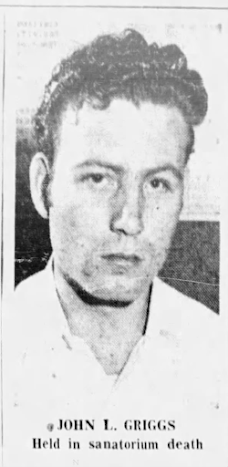
Murder At Waverly Hills Sanatorium


Instead of typing out an entire blog on this case, I decided to share the newspaper clipping from the Louisville Courier-Journal, Louisville, KY, March 2, 1954 along with subsequent articles.


Louisville Courier-Journal, Louisville, KY, March 2, 1954 


Louisville Courier-Journal, March 6, 1954.


Louisville Courier-Journal, April 22,1954


Tuesday, March 5, 2024

A Lynching In Rowan

 The following story was written by Dr. Jack Ellis and published in the Morehead News on July 7, 2000.  The Morehead News is no longer in publication and Dr. Ellis has since passed on.  So to keep this story from being lost to the sands of time, I thought I would publish it here, word for word, just as Dr. Ellis wrote it.


If a man be just, and do that which is lawful and right ... he shall surely live. Eze 18:5,9.


Evidence of early Rowan County's lawless and violent reputation was evident by an article that appeared in the "Bracken County Record" dated April 4, 1877. (Thanks to Nan Lytle for sharing this material)

The crime committed

John R. (Jack) Tabor was a Rowan resident who had resided in the Cranston area of Rowan County. Mr. Tabor had been in trouble with the law on several occasions. He had an unsavory reputation not only in Rowan but also in the neighboring counties. John P. Martin was one of Tabor's neighbors, and a companion in crime.

On a Saturday night in early April 1887 after getting drunk on their homemade moonshine, Tabor and Martin hatched a plan to steal two horses and skip the country. After stealing the horses, the two men headed north toward the Ohio River. On Sunday, they were seen passing through Flemingsburg. By Monday morning they reached the Ohio River at Foster, a small town down river from Augusta in Bracken County. It was their intention to board the Bonanza, a paddle wheeler, headed 42 miles down river to Cincinnati. There they would sell their stolen horses at the stock sales'.

The Bonanza was not 'due at Foster until Wednesday, so the two men camped on the dock waiting for the arrival of the steamboat. Also a part of their plan was for John Martin's wife to come to Maysville and board the Bonanza. She would then meet them down river when the boat docked at Foster. There the three would continue on to Cincinnati together. Martin's wife booked passage on the Bonanza on Tuesday right on schedule. But she evidently caught the attention of the local Marshall since he had just been notified of the two horses stolen in Rowan County. Also he had been told that the woman waiting to board the boat was from Rowan County.

When the Bonanza left Maysville headed down river, Maysville Marshall Heflin and Jail er Weedon were also on board. They were determined to "shadow" Mrs. Martin, believing she was involved in the crime. How did the Marshall in Maysville find out so quickly about the stolen horses in Rowan County? There were no railroads or any form of fast communication in Rowan County in 1877.

The news spreads Warren Alderson, owner of one of the two general stores in Morehead in 1877, was a church-going man. He arose on Sunday morning and attended church services held in the Rowan County Courthouse. As he came out of the meeting, he saw the sheriff ride up on his horse. The sheriff told Mr. Alderson that two horses had been stolen in the Cranston area on Saturday night and described the stolen horses to the storekeeper. He then asked to keep a look for them.

Before daybreak on Monday, Mr. Alderson left Morehead in his wagon on his weekly trip to Maysville, Kentucky hauling freight, mail and passengers. (Later on he hired a driver to make the weekly round trip but in 1877 he was making the run himself.) His wife always ran the store during his absence. When Mr. Alderson passed the Mt. Pisgah Church in northern Rowan County, there was a woman who stopped his wagon and paid her passage to Maysville. Mr. Alderson knew about everyone in the county and recognized her as the wife of John Martin. She told him she was on her way to Cincinnati to meet her husband.

Suspicion aroused

Mr. Alderson always stopped in Flemingsburg overnight and Mrs. Martin stayed at a local inn and Colonel Alderson, famous for squeezing a penny, slept in his wagon while the horses rested that night. They were off again at daybreak on Tuesday morning and arrived in Maysville about noon. Mrs. Martin climbed down from the wagon and walked down to the dock. Warren went to a local restaurant to eat lunch and saw Maysville Marshall Heflin, and told him about the stolen horses in Rowan County and gave him a description of the animals. He also mentioned that his passenger was Mrs. Martin from Rowan County on her way to Cincinnati. Evidently the Marshall knew of Martin's reputation so he became suspicious and he decided to follow her. His suspicions paid off much to the detriment of the two horse thieves.

When the steamboat docked at Foster, Jack Tabor and John Martin boarded with the two stolen horses. After the boat returned to the middle of the Ohio River, Martin and Tabor met with the "suspicious" woman. While they were talking, the Marshall and jailer examined the two horses and they matched the description of the stolen animals.

Criminals arrested

The Marshall then arrested the two horse thieves and ordered the · captain of the sternwheeler to return them to Foster and the Marshall, the jailer, and the two thieves embarked with the stolen horses. The two men and the woman were returned to Maysville on Wednesday night and were placed in jail. However, on Thursday morning the two men consented to return to Rowan County for trial, along with the two horses which were returned to their owners.

Jack Tabor lynched

Evidently people in Rowan County were in no mood for leniency, and Jack Tabor's previous brushes with the law had caught up with him. His punishment was swift and sure. According to a dispatch one week later in the Bracken County Record, Jack Tabor, the horse thief who had been arrested on the steamer Bonanza, was lynched . It cannot be determined for certain that Jack Tabor's death was due to a trial by his peers or taken from the jail and lynched. But it is the writer's opinion that there was not enough time to hold a trial, and the report used the word "lynched." Here are the exact words used in what the Bracken County paper called "A Later Dispatch."

"A report has reached us via Maysville that John R. Tab6r of Rowan County, the horse thief who was arrested here Wednesday on the Steamer bonanza was lynched in Morehead."

It seemed the report reached back to Bracken County in about one week after the men were returned to Rowan County. Also the report used the word "lynched" which was not a word used when prisoner was legally hung as the result of a trial. Therefore, it is this writer's opinion based on the evidence, that Jack Tabor was removed from the Rowan County Jail and lynched by the "Tiger" guard. The Tiger guard was an extreme vigilante radical group of the Home Guard. The Home Guard was a group of citizens in Rowan County organized to protect life and property during and after the Civil War. It could have been that group; or just some citizens who were tired of the criminal element in the county, and they were determined to make an example of Jack Tabor. I'm sure there were other lynchings in Rowan County, but his is the only evidence this writer had found so far of a lynching in Rowan County. Also, please remember that lynching was seven years before the start of the Rowan County War which brought this county its reputation for violence.


Saturday, February 3, 2024

Shootout At Carver


Headline from the Paintsville Herald
Paintsville, KY
August 23, 1928


On August 21, 1928, a shootout took place in the Magoffin County, Kentucky community of Carver. When the gunfire was all over, one lay dead and two others seriously wounded; and one of them would die days later.


There are multiple versions of the story, but trouble between the men began over a labor dispute in which miners were on strike.


One version reports that Tony Push, age 28, left a note on the office door of Superintendent J.L. Blevins (also saw the name listed as Sam Blevins) that said, "Do not let the sun go down on you here." In other words, if Blevins didn't leave within a certain number of hours, he would be killed and leave the camp in a coffin.


Blevins refused to comply with the demands and wrote on the same note "The sun may go down on me, but if I go out, others will ride the same train."


At 5:00 P.M., Push and Arlie Cole allegedly visited the superintendent's office to execute the threat, and the shooting followed.  Blevins was shot six times. Blevins was able to return fire, shooting Push and Cole multiple times each.


According to reports, Cole was shot several times in the bowels and Push received a wound to the thigh and wrist.


The other version of the shooting is that Blevins had discharged Push, who was a driver and ordered him to put his vehicle in the barn, which he did. Later, another driver was put in charge of the vehicle.  Push, accompanied by Cole, went to inquire of Blevins as to why he was discharged.  Blevins is alleged to have been drinking. When Push confronted him, Blevins pulled his gun and began firing at Push and Cole, who both returned fire. 


Only one other man was alleged to have witnessed the shooting.


The three wounded men were placed on a special train and started to the hospital at Paintsville. Blevins died before reaching the hospital.  He was taken to the undertakers at Paintsville Furniture company and prepared for burial.


Cole and Push were operated on by Dr. W.R. Castle and staff of the Golden Rule Hospital.  


According to reports, Cole's intestines were perforated in at least three places. They were sewed together in an effort to save him; but little hope was given for his recovery.  He died on August 28, 1928.  

headline from the Paintsville Herald
Paintsville, KY
August 28, 1928.


Push on the other hand was expected to make a complete recovery.


I was unable to confirm if charges were filed or were not filed against Push.  According to sources, he relocated to Michigan in 1949.


Arlie Cole is buried at the Peter Williams Cemetery in Magoffin County, Kentucky. And according to sources, Blevins' remains were taken to Ft. Gay, WV for burial.

Wednesday, January 31, 2024

"Don't Tell Mother" - The Murder of Dayton Wireman

 On the afternoon of January 21, 1935, a shot rang out in the Salt Lick community near the Floyd and Knott County line.


When it was over 18-year-old Dayton Wireman had been shot by Whitt Howard, a Breathitt County youth. 


The shooting occurred near the home of Willie Shepherd.

According to informants, Wireman, Howard, and Howard's father Wiley Howard, had been firing revolvers and a shotgun in the vicinity of the slaying and Wireman had slipped and fallen.

While he was washing up from the creek, Howard approached him, leveled a shotgun, and from a distance of only a few feet fired the weapon, striking Wireman in the left side.

The two had not had any previous trouble at all and no reason for the slaying had been established other than the claim that Howard thought Wireman had been shooting at his father.

After being shot, Wireman turned and walked to the home of Willie Shepherd where he fell upon the bed.  When asked if he wanted a doctor, Wireman responded, "I don't need a doctor---I'm killed.  But don't tell my mother."  He died within five minutes of making that comment.

Howard, his father and brother bought a supply of ammunition and left the scene of the shooting, going in the direction of their home on Spring Fork of Quicksand Creek in Breathitt County.  The next day, he was arrested on a drunkenness charge on Roch Fork by Deputy Sheriff Nick Brewer and was taken to Hindman.  It was there that it was learned that he was wanted in Floyd County for murder.  He was returned to Floyd County by Deputy Sheriff R.R. Allen who had been searching for him.

On Saturday, February 16, 1935, Howard was convicted by a jury of the Floyd County Circuit Court for the murder of Dayton Wireman and was sentenced to 21 years in prison.

During the trial, the jury held that in the killing of Wireman the drinking and shooting was of a general nature and, therefore took the position that the shooting was of the nature of a drunken row.

However the Commonwealth testimony showed that Wireman was shot when offering no threat to Howard. He and others had been at the home of Howard's brother, and he had fallen outside. After washing himself at the creek nearby, he fixed his revolver over his shoulder, but not in the direction of any of those present.

A moment later, Howard fired the shotgun into his side.

The Commonwealth also produced evidence that Wireman, after being wounded, told those around him that he had not intended to offend anyone; and that, as he ran toward the home of Willie Shepherd, where he died, Wiley Howard, father of the slayer, fired shots at him and was prevented from following him inside the house.

The defense testimony was to the effect that Howard thought Wireman had fired upon his father and that he shot Wireman in defense, as he believed, of his father's life.

Howard accepted his sentence without appeal.

After the funeral services at the home of his mother, Wireman's remains were interred in the Wireman Cemetery in Magoffin County, Kentucky. He was survived by his mother, stepfather, and countless other relatives.
Dayton Wireman


Forgotten Kentucky: The Day a Fighter Plane Chased a UFO Over Fort Knox

  Courtesy of The Morehead Minute Newsletter: By Joe Clark For The Morehead Minute Long before The X-Files , before Project Blue Book becam...