Sunday, July 23, 2023

Mysteriously Murdered

 A lot of times when I post one of  these blogs, someone will read it and it will remind them of a similar situation or case. So they will contact me and tell me about their case or ask me to see what I can find.  And I love it. I love researching history, particularly old crimes. 


Such is the case with this one.  I posted a blog about another historic crime. Larry Cheek read it. And in return, he told me about a crime the crime that I'm about to cover. And up until then I was not aware of it, even though it was a horrible crime. So thank you, Larry.


So let's jump right in to "Mysteriously Murdered."


Headline from the Messenger in Madisonville, KY, March 4, 1955.

It was Thursday afternoon, March 3, 1955. Chris Smith came home from a visit to Manchester. What he found when he got to his home on Little Goose Creek  was something so horrific that it sounds like something from a horror movie - he found his four children, three boys and one girl, all had been murdered with a shotgun. They all had been shot in the head.  The victims, ranging from 25 to 39 years of age, were identified as Leonard, George, Chester, and Venice Burns Smith.


One son and the daughter were sitting upright at the dinner  table in the kitchen. A meal had been prepared and the table was set  but the food had not been touched.  The other two sons were found in the bedroom. One was sitting on the bed in an upright position and the other had fallen against the bed from a bench.


There was no sign of a struggle and no motive for the shooting, which occurred sometime between noon and 2:30 P.M.

Photos of the bodies as they were found. Clipped from the Lexington Herald, Lexington, KY
March 6, 1955
.


Troy Ernest Smith, a younger brother of the victims, told authorities that Walter Cupp and Reuben Hibbard, both of Portersburg, a community about a mile from the scene, were at the Smith home when he left there at 10:00 A.M. He stated there had been no trouble up to that time. Hibbard was a brother-in-law of the victims.


Jailer Matt Sizemore stated that the victims' mother was at Hibbard's home visiting her daughter at the time of the slayings.


Cupp and Hibbard both were arrested and charged with the murders. According to Kentucky State Police Detective Walter Woods, there was evidence of considerable drinking at the home, and that a passerby reported seeing Hibbard and Cupp leaving the area of the Smith home shortly before the bodies were found. 

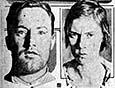
Reuben Hibbard and Walter Cupp
clipped from the Lexington Herald, Lexington, KY
March 6, 1955. I colorized the photos.


Two days after the shooting, suspect Reuben Hibbard (also seen the spelling as Rubin) voluntarily took a lie detector test. The results were not released at the time.  Hibbard asserted in a statement that he had been at the shooting scene but left before any shots were fired. He stated that he went into a bedroom where he saw Cupp and the girl sitting on the bed.  Cupp, according to Hibbard, ordered him to leave the room. 


According to Hibbard, George Smith told Cupp three times to leave the house. Smith then took a high powered rifle from a rack in a bedroom but Hibbard took the gun from Smith and put it on a bed.


Hibbard stated that he went to the kitchen, picked up some groceries the girl had brought from a nearby store, and left. He said that he had been in the Smith home for about four hours.


  Hibbard went on to say that about three-fourths of a mile down the road he met Chris Smith, the father of the victims. He said he told Smith "You'd better hurry and get there; it looks like there's going to be trouble."  


 The other suspect, Walter Cupp, remained silent and refused to answer questions or make a statement about his activities.


That same day, more than 200 people attended the funeral service for  the victims, who were buried  in the Cupp Cemetery at Urban, Kentucky.


The examining trial was set for Monday, March 7, 1955. Several hundred people,  tried to find seats in the courtroom but there wasn't enough room to accommodate the crowd which was estimated to be "at least a thousand." But most left when they learned the examining trial was being postponed until the following day. The court of inquiry was held behind closed doors.


Commonwealth Attorney Garfield Drinnon stated that he would not ask for a special session of the grand jury to investigate the slayings, stating that the court of inquiry had served that purpose. He said the men would go before the May grand jury and would be held without bond. 


In an interview, the victims father, Chris Smith, sobbed openly. He said "none of my family has ever been in trouble. Since the killing I've not been back. I am afraid they will kill me. There will be more trouble and probably my home burned."  He went on to add "I've been staying with neighbors in my community, afraid the rest of my family would be killed. It ain't that I'm afraid of my life, but for my family."  He also added "I can't stand going back to that house and I ain't ever going back there again.  I hope the one that did it will burn, but I'm going to let the Good Lord settle it. Lord, help me. I can't stand it."


Smith expressed an opinion that the weapon used was an automatic shotgun that he kept at the house. He told reporters that when he left home last Thursday the gun was there and that it contained five shells. Four empty shells were found in the house, but the weapon had not been found, according to officials.


The next day at the examining trial before Judge Charles H. White, both Hibbard and Cupp were held to the May term of the Clay County grand jury without bond. Neither man testified at the hearing and only four witnesses were heard according to Sheriff Daniel Davidson. About 800 people filled the courtroom to hear the Commonwealth offer three witnesses.


The father, Chris Smith, said he met Hibbard "just outside the house a piece" as he was returning from Manchester.  He said Hibbard, who had asked to borrow his car, apparently had been drinking but did not mention the killings.


"When I got home the door was open about two feet", Smith testified. "I looked and saw George lying down in the floor with his head about blown off.  When I saw this terrible sight I broke and run for help."  


Smith said there had been no previous trouble between him and Hibbard and he didn't believe Hibbard would harm the Smith family in any way.


Troy Smith, the victims' brother, said Hibbard and Cupp were drinking when he left the Smith home that Thursday.  He stated that Hibbard told him "George is shot and they're laying it on me and Cupp."  Smith also stated that there was a jug of liquor sitting on the floor but that his brothers and sister did not touch it.


The only witness the defense called was Albert Rich, who said he took Chris to Manchester to get his car fixed.  Rich testified that he later met Hibbard and Hibbard told him "you out to have been there and saw that fight a while ago. You should have seen Shorty (George Smith)...."


Rich testified "I told Reuben 'you all wouldn't fight a flea.'"


On Tuesday, May 3, 1955 both Walter Cupp and Reuben Hibbard, were each indicted for four counts of murder.  Clay Circuit Judge Billie Dixon denied bond for both men, and set the trial for May 23, 1955.


Cupp was represented by former county judge Attorney John Lyttle.  Hibbard was represented by former assistant attorney general Roy House and former judge Franklin P. Stivers.  The prosecution would be handled by commonwealth's attorney Garfield R. Drinnon and Charles C. Smith.   Circuit Judge Ray C. Lewis would preside over the trial.


On Monday May 23, 1955, the jury of ten men and two women was chosen; and the trial got underway.  During Monday's proceedings, the murder charges against Reuben Hibbard were dropped in a surprise move by Commonwealth Attorney Garfield Drinnon. Drinnon said that an investigation had produced no evidence against Hibbard. However, Hibbard would become the prosecution's star witness and therefore would be remanded to jail for protective custody. 

Headline from the Lexington Leader, Lexington, KY, May 24, 1955. Headline is referring to the charges being dropped against Reuben Hibbard.


So it was now just Walter Cupp on trial , this time for the murder of Miss Smith.  The trials for the murder of the other victims would take place at a later date.


During this trial, the prosecution called four witnesses, including two members of the victims' family.


The first witness was the 70 year old father of the victims, Chris Smith.  He testified that he met Hibbard while returning from a trip to Manchester on the day of the shooting.  He said Hibbard asked to use his car and he refused because Hibbard was "about two-thirds drunk."  


The elder Smith told of entering the house and finding the bodies. He said he noticed that one of the three guns he owned, an automatic shotgun, was missing from the house.


Troy Smith, the younger brother of the victims, testified that he had been in the cabin  that day and he found both Cupp and Hibbard there with his brothers and sister. He said they were all drinking from a bottle of whiskey on the floor of the cabin. He also  testified that all three of his father's guns were in the house when he left.


Two other witnesses, Mary Lee Allen (16) and Daisy Pearl Bowling (11), students at the Urban School testified they saw Cupp pass the school on the morning of the shooting. They stated that he was headed in the direction of the Smith residence.


The trial continued the next day, Tuesday May 24, 1955.  It was then as Commonwealth Attorney Garfield Drinnon was summing up the case, he was interrupted by a youth who shouted "You're not telling that right! Let me tell it!"  The youth was arrested and was identified as 19 year old Clarence Benge.


Cupp denied firing the shots that killed the Smiths but admitted that he had been in their home earlier that day. He said that he left around 11:00 A.M. for Kincaid, a nearby community and then visited a brother.


Reuben Hibbard testified that an argument developed between Cupp and George Smith over  Cupp's attentions to his sister, Venice.  Hibbard claimed that he left the house around 3:00 P.M. and that Cupp was still there.  Hibbard stated "after I got about 300 feet down the road, I heard four or five shotgun shots."  


Under cross examination, Hibbard said he had remained silent about the shots because he was afraid "Cupp would kill me."


 And after deliberating for more than 30 minutes that evening, the jury reported they were unable to reach a verdict.  Judge Dixon  then instructed the panel to return at 9:00 A.M. the next day and resume deliberations.


The very next day, Wednesday, May 25, 1955, the jury deadlocked. It had resumed deliberations that morning, but reported an hour later it could not agree. Judge Dixon then instructed them again to try again.  But at noon they still were deadlocked.  So the judge dismissed the jury and said he would set a new trial date for Cupp.

Headline from the Kentucky Post And Times-Star
Covington, KY, September 16, 1955.


Defense attorneys stated that they would ask the Clay County Circuit Court to set a reasonable bond for Cupp the next day.  Judge Dixon said resetting of the trial would depend on the outcome of  the defense's request.


Commonwealth Attorney Garfield Drinnon said he would recommend that Cupp be held without bond, stating "I'm more convinced than ever that Cupp is the man who killed the Smiths."


Cupp ended up being held without bond, and on September 6, 1955 a trial date was set for 

September 14, 1955.


On September 13, 1955 Circuit Judge Billie Dixon ordered a jury from nearby Knox County to hear the trial of Cupp.  Judge Dixon asked the Knox County  Sheriff to summon 75 prospective jurors for the trial, which was scheduled to start the next day.


Acting Commonwealth Attorney Roy House asked for an outside jury because the last trial was attended by overflow crowds, was too widely publicized, and the defendant has a "long string of relatives" in Clay County. House stated that a "Clay County jury would be made afraid to render a fair and impartial verdict because  lawlessness exists in Urban where the slayings happened..."


Just as planned, on the following day, September 14, 1955, the trial got underway.  The courthouse was jammed and the halls were crowded when the trial got underway around 11:00 A.M. 


 Once again, the prosecution introduced a surprise witness, Ida Mae Benge. Mrs. Benge had not testified in the previous trial.   During her testimony in which she broke down and sobbed, Benge testified that she "felt sure" she saw Cupp leave the Smith home around 5:00 P.M. on the day of the murders. She stated that he left the Smith home and go toward the community of Benge in Portersburg.


During the trial Cupp appeared nervous at times, but later told reporters, quote, "I'm not a bit scared of what the jury will do. I didn't kill the Smiths and I aint got a thing to worry about."


Acting Commonwealth's attorney Roy W. House stated that he would prove that the motive for the slayings was Cupp's desire for sexual relations with Venice Smith.


Others who testified that day were Chris Smith, father of the victims and Troy Smith, the brother of the victims, Reuben Hibbard, and Detective Woods.


Chris Smith told of told of finding the bodies, as he wiped his eyes with a handkerchief.  He also said that he found his 30-30 rifle and his 12-gauge shotgun in the house but that his automatic shotgun, which was believed to be the murder weapon, was missing.


Troy Smith said that he left his home on t he morning of the slayings after having a few drinks of moonshine from a gallon jug with Cupp, Hibbard, and two of his brothers.  


Hibbard said he was at the Smith home but left around 3:00 P.M., leaving Cupp at the Smith home.  He stated that Cupp and George Smith had argued over Cupp's attention to Venice Smith.  He said that after Venice returned from a store, Cupp went into a bedroom with her.  Hibbard said he went into the room and that Cupp ordered him away, saying he (Cupp) intended to have relations with the girl.


Hibbard went on to testify that as he was walking a short distance from the Smith home he heard "four or five" shots from a shotgun.


Detective Woods told of his investigation of the case and said the two weapons found in the  house had not been fired for "two or three days" before the slayings. He said he believed the missing gun was the one used to kill the Smith family.


Testimony from an FBI agent from the first trial was read as was a previous testimony from Rev. James Clark, a teacher in the Urban School at the time of the slayings. Rev. Clark had recently undergone an operation and was unable to appear in court.


With that, the court was adjourned until 9:00 A.M. the next day.


The next day, the trial reconvened with Cupp being the principal witness of the day. 


Cupp testified  that he went to the Smith home around 9:00 A.M. on the day of the quadruple murder to buy a pint of moonshine. He said that in addition to the Smiths, Reuben Hibbard was present.


According to Cupp, Hibbard and George "Shorty" Smith got into an argument over $11.05 which Hibbard claimed Smith owed him. Cupp admitted to having "a couple" of drinks of moonshine with the others from the jug on the floor.


Cupp claimed that he bought a pint of moonshine from George Smith and left the house around 10:00 A.M. and that Hibbard and Smith were still arguing when he went out.


Cupp said that  he proceeded to the home of John Bowling where he had lunch and then helped Bowling repair a fence.  From there he went to the home of his brother Ben Cupp where he fed some cattle and had dinner.  He then went to the home of Clarence Spence to spend the night.


Minnie Mae Smith, 17, testified that she had heard Hibbard threaten to kill "Shorty" Smith about two weeks before the slaying while she was staying at the Hibbard home. She said Hibbard told his wife, "I know that Shorty took my $11.05. If he don't give it back, I'm going to blow his brains out."


Albert Rich, 27, testified that one of his activities on the day of the murders was flying a kite. Rich stated that he accompanied Chris Smith, the victims' father, to Manchester that morning. Smith had his car fixed and that he himself had purchased a kite.


Returning to Urban, Rich said Smith got out of the car and walked the quarter of a mile to the Smith home, while he went into a field and started flying his new kite.  He stated that  while he was flying the kite, Hibbard walked up and offered him a drink of moonshine.  He said  that both took a drink and Hibbard told him "You ought to have been t here and seen that fight a while ago. You should have seen Shorty - I messed him up."


Rich responded to Hibbard "I don't believe a word of it, because you wouldn't fight a flea."  Hibbard returned to the stand and denied that he had spoken about any fight to rich.  


Detective Walter Woods also returned to the stand. It was Woods that  had arrested Cupp the night of the slayings at Spence's home.  Woods stated that when he entered the house, Cupp said "Walter, I guess you're looking for me." Woods then asked Cupp what he had done with the gun. Woods said that Cupp responded "I don't know a damn [thing] about any gun."


In closing for the state, acting Commonwealth Attorney Roy House asked the jury to return the death penalty against Cupp.


The jurors deliberated for three hours before acquitting Cupp of the murder of Venice Smith.


Cupp was now cleared of one of the four murder charges. He still faced murder charges for the other three victims.  No trial date had been set for those  trials, so Cupp was returned to jail without bond pending the outcome of those trials. The next day, the trial date for the other three murders was scheduled for October 5, 1955.


Although scheduled for October 5, 1955, the trial actually did not get underway until two days later, October 7, 1955. This time a jury from Madison County was hearing the case.   Detective Woods said that new witnesses and evidence would be presented during this trial.


Just as it was in the previous two trials, as "surprise" witness appeared to testify in this trial as well.  Earl Gregory, 22, told the court that he met Cupp near the Smith home on the day of the slayings. He said Cupp told about going to the Smith's home to buy moonshine and had trouble with them. Gregory stated that he had been away and therefore unable to testify at the previous trials. 


The trial continued the next day. Cupp again gave the same testimony as in the previous trial, almost word for word.   At the conclusion, the all male jury deliberated for an hour and a half before acquitting Cupp of the murder of Leonard Smith.

Headline from the Lexington Herald, Lexington, KY
October 9, 1955.


After the verdict, Judge Billie Dixon told Cupp, "I don't know if any jury will ever point the finger of guilty at the person who committed this heinous crime against the Smith family, but there is still an all-seeing , ever-present just God waiting to render a righteous judgement agains the person who committed that terrible crime. Before God there can be no denying of this crime. I'd hate to meet my God with this kind of a crime against me."


Chris Smith, the victims' father asked that Cupp be placed under peace bond, saying that he was afraid of him. State's attorney Roy House told the judge there was not sufficient proof to place Cupp under peace bond.


Then Judge Dixon sternly warned Cupp, "If I ever hear of you doing anything or getting into trouble or on suspicion, I'm going to bring you back to jail, see that you stand trial on the other two slayings, and keep you in jail as long as the law will permit me." Judge Dixon  said that Cupp would be tried on the two remaining murder counts IF new evidence is presented.  Cupp was released on a $35,000 bond on each of the other two deaths.


And this is where it ended as far as I can tell. I'm assuming no new evidence was ever presented because I found no record of Cupp being tried for the other two murders.  Larry Cheek, who told me about the case, said that no one was ever charged in the murders. So I'm assuming that the second acquittal was the end of it all.   The only other mention of Cupp that I could find was his obituary from May 1996. 


As a personal note, I thoroughly enjoyed researching this case.  And based solely on the newspaper reports, I can see why both men were acquitted. There were too many inconsistencies in the testimonies from the prosecution side, especially in the  testimonies of the victims' brother Troy.  And Chris initially said that he saw the bodies and ran for help, but then later stated that he noticed a missing gun. So did he run for help or did he look for a gun?  There were just too many inconsistencies.


Most likely no one but the perpetrator and God will ever know exactly what happened that day, other than 4 people were brutally murdered in  the prime of their lives.


Friday, July 21, 2023

An Ancestral Tree of Crime


As you can probably tell by reading my blogs, I have a huge interest in historic  true crime.  I love all history, but historical crime seems to be my favorite niche.  


It all started in my days of being a paranormal investigator. A lot of the alleged hauntings stem from tragic events- a disaster, crime, feuds, wars, etc.  After years of investigating the paranormal I begin to find myself more interested in the history behind the alleged haunting than I was the alleged haunting itself. 


Then in 2014 I began researching my family ancestry.  Up until then I really had no interest in  doing so.  And I continue to research to this very day. 


It is amazing what you can learn from it. I have had ancestors who fought in the Revolutionary War, The Civil War, and many of the other wars.  I've found ancestors who founded towns and cities. My cousin Francis Scott Key wrote the "Star Spangled Banner" , our National Anthem.  I even have Elvis Presley in my ancestral tree.  Sadly but true, my ancestral tree also has more than it's share of criminals - I mean famous , notorious criminals.  It's to the point that anytime I read about a historic crime,  I go search to see if I'm related to the perpetrator.


Today I will share with you some of those corrupt fruits from the family tree with you.

Charles Manson

Charles is my 9th Cousin 1x removed


1) Charles Manson - The leader of the Manson Family who were responsible for numerous murders in the Los Angeles area as well as other parts of California. Many don't know this, but Manson's roots run deep here in Kentucky. In fact I did a blog about that if you want to go back and read it.  So I was not too suprised when I found out that he was in my ancestral tree, especially given the fact his mother was from my hometown.  Charles is my 9th Cousin 1x removed on my Dad's side of the family.

Jim Jones


This shows my how I'm related to Jim Jones (8th Cousin twice removed.


2) Jim Jones - the cult leader responsible for the Jamestown Massacre which ended with 918 people either being murdered or by suicide.  Jim is my 8th cousin twice removed on my Dad's side of the family.


David Koresh
This shows how I'm related to David Koresh (9th cousin 1x removed.

3) David Koresh (Vernon Wayne Howell) - cult leader of the Branch Dividians. He and 74 of his followers were killed during a standoff with the FBI, in which their compound burned to the ground. David was my 9th cousin 1x removed on my Dad's side of the family.


Jeffrey Dahmer
Dahmer is my 9th cousin

4) Jeffrey Dahmer - the serial killer in Wisconsin. Jeff was responsible for the deaths of an estimated 17 men and boys, many of whom he cannibalized. Jeff is my 9th Cousin on my Dad's side of the family.


Ted Bundy
Bundy is my 12th cousin once removed


5) Ted Bundy - serial killer convicted of three murders and possibly as many as 100 more. Ted is my 12th cousin once removed on Mom's side of the family.

John Wayne Gacy

John Wayne Gacy is my 8th cousin 3x removed

6) John Wayne Gacy - serial killer linked to the rape,torture, and murder of at least 33 men and boys in Illinois.  John is my 8th cousin 3x removed on Mom's s ide of the family.


Jack & Louise Hathcock


Dorothy Anderson is Louise Hathcock's sister. I had to use Dorothy to get a direct line to Louise because it was tying Louise to me via Jack. I wanted a direct line to Louise to show my relationship to her directly. So I had to use her sister.


7) Clyde Raymond "Jack" Hathcock & Laura Louise Anderson Hathcock - leaders of the State Line Mafia - you are probably familiar with Sheriff Buford Pusser from the "Walking  Tall" movie fame. Well the arch nemesis for the real Sheriff Pusser were Jack & Louise Hathcock. They were the leaders of the State Line Mafia, which was based along the state line between Corinth, Mississippi and McNairy County, Tennessee. No one knows the exact numbers, but the State Line Mafia were believed to be responsible for several deaths.  Louise shot and killed Jack in 1964 so she could have an affair with another member of the mafia.  Then Sheriff Pusser shot and killed Louise in the line of duty in 1966.

Jack and Louise both show up in my ancestral tree. Jack is my 8th cousin 3x removed on Mom's side of the family. And Louise is my 10th cousin once removed on Dad's side of the family.  I'm planning on doing another blog specifically about Louise in the near future. 

Ironically Sheriff Pusser and his wife Pauline both are in my ancestral tree as well. I may dive into that at another time.


Manzo Shepherd


8) Manzo Shepherd -  Manzo Shepherd was a very interesting character. I would suggest you buy the book "The Manzo Shepherd Story" on Amazon.  Manzo killed taxi driver Joe Christian in a robbery attempt on top of Black Mountain in Harlan County, KY. Within one month Shepherd was shot and killed in a Harlan Courtroom in front of 300 people.  That's all I will share with you in case you want to read the book. The story made headlines around the country.

Anyway,    Manzo Shepherd is my 9th cousin 3x removed on my Mom's side of the family.


And there's more!!

I am also related to outlaw Jesse James!  My 5th Great Grandmother was a sibling to Jesse's Great-Grandfather. This is on my Grandmother Lucy Esham Clark's side.


And lastly, I am related to outlaws Bonnie Parker and Clyde Barrow aka Bonnie & Clyde!!  I had to use Bonnie's baby brother Coley instead of her. Someone has her information all screwed up. So I just used her brother to get our relationship.


Bonnie is my 9th cousin 3x removed on my Dad's side  and Clyde is my 8th cousin 3x removed on my Mom's side.


Coley was Bonnie Parker's Infant Brother. I had to use him to get the relationship because someone has Bonnie's genealogy information all messed up on FamilySearch.


I could probably find more if I would spend the time digging in ancestry.  


Now, I know what you are wondering, that being "how accurate is your source?"  Well I use FamilySearch ancestral research  site.   They have an accuracy rating of 75%  So that means  they are accurate 75% of the time most of the time. Of course there is that 25% chance of them being inaccurate.  But  the chances of being accurate are greater than the chances of being inaccurate.


Your next question is probably "are you bragging about having these people in your ancestral tree?" No I'm not. I am not condoning  their actions at all.  And in all cases, the relationship is so distant that it really doesn't amount to much. But could their lives of crime be the reason that I have such a huge interest in historical crimes?  That's my question - and I may never know the answer. 


Wednesday, July 19, 2023

Killed For Love

When it comes to the murder of children, Carter County, Kentucky, specifically Western Carter County, seemed to have more than it's share of cases over the years.

 In 1915 you had the murder of 16 year old Stella Kinney. In 1932, you had the murder of ten year old Roy Rickey. And 1936 would add another innocent child to the list.

 Everett Sparks was married to Pearlie Dean Sparks. They had at least three children that we were able to find: William Toy Sparks, Mildred J. Sparks, and Erie Marie Sparks. Mildred was crippled, unable to walk or talk.

 Pearlie passed away in 1935 from Tuberculosis, shortly after giving birth to Marie. After Pearlie's death, Everett was married again. This time to Nella (Nellie) Brown of Elliottville in Rowan County,KY.

Initially Everett claimed that Nellie had threatened to leave him if Mildred, being deaf and mute, remained in the home. Everett was quoted as saying that his wife said the child was 'too much trouble" , and if he didn't get rid of the girl by Sunday (October 25, 1936), she would leave him.

Given the alleged ultimatum, Everett chose to kill the child. So on Thursday, October 22, 1936, Everett borrows 25 cents, goes to the Rose & Sparks Drug Company in Olive Hill and buys some arsenic under an assumed name of Sam Jones. Everett takes the arsenic home, puts it in sweet milk and gave it to Mildred.

 Neighbors stated that the child died in extreme pain, frothing at the mouth and that no effort was made to call a doctor. And they were told by the Sparks' to "get out" that they were not needed.

 Mildred passed away the next day (Friday) and was buried Saturday without a death certificate being issued. The neighbors then went to the authorities and made a report. This prompted the county attorney and the county coroner to visit the Sparks home to investigate on Tuesday.

 An investigation proved that a large quantity of poison had been sold at the local drug store the week prior to a resident of Enterprise (a community a few miles outside of Olive Hill) and that Sparks had been in town that day.

Two days later, on Thursday, Sparks went to the coroner's office and confessed to the crime. Both Everett and his wife Nellie were arrested and charged with the murder of Mildred.

Everett's Confession, clipped from 
the Olive Hill Carter County Herald,
October 29, 1936.


Believing that Everett and Nellie might alter their plea, County Attorney J.R. McGill and Coroner C.W. Henderson had the child exhumed. They wanted to back up the written confession that Everett had made that he fed the arsenic to Mildred. So a post-mortem examination was conducted on November 16, 1936.

The post-mortem examination found quantities of arsenic in the girls stomach and liver and that the walls of the stomach were reddened and congested.

On November 25, 1936, both Everett and Nellie were indicted on the charge of murder. Nellie's bond was set at $10,000.00 and Everett was held without bond. Their trial was initially set for the following week. However, their attorneys, R.H. Wilhoit and Thomas Theobold, Jr, withdrew from the case, causing the trial to be moved to December 17, 1936. 

 No cause was found, but for whatever reason, the trial was moved to February 1937.

 Nellie was tried on February 20, 1937.

 The eight year old son of Everett was a witness for the prosecution. He told how Nellie told Everett that he had not given the child a sufficient amount to kill her, and to let her give a dose that would get her out of the way. The son stated that then Nellie prepared a cup of milk into which she poured the medicine and mixed it and the child drank it.

 Throughout the process, Nellie continued to deny that she had anything to do with the murder of Mildred. She did admit to threatening to leave Sparks but insisted that she had nothing to do with the murder. She said that she would have treated the girl as she would have her own child.

 That trial ended in deadlock forcing a retrial the following week.

 The jury in the retrial must have believed her story over the son, or perhaps their wasn't enough evidence linking her to the crime; because on February 26, 1937, Nellie was acquitted by a Lawrence County jury of twelve men.

Clipped from the Olive Hill Carter County Herald
Olive Hill, KY, March 4, 1937


 Everett on the other hand plead guilty and received a life sentence for the murder.

 Nellie passed away in 1992 and is buried in Greenville, Tennessee. Everett passed away in 1957 and is buried alongside his first wife Pearlie in Globe, KY. Ironically Mildred is the only child buried with her parents. The child Everett didn't want in death is the only one buried close to him.


Wednesday, April 12, 2023

Pitts’ Murder Captivated The World


The following article was written By Jeff Phelps and published  as a special to The Greenup Beacon, Greenup, KY.  The article is still up on their website, but unless you pull up an archived version, the pictures are no longer available with the article.  So I decided to copy and paste the entire article, word for word, with photos here on the blog.


  Mary Magdalene Pitts was struck down at the tender age of three. Her story of torture and murder sparked a nationwide furor that still echoes today.The monument that marks her grave has become a shrine for the residents of Greenup County. Dolls, stuffed animals and toy cars are still left for her 92 years after her death. She lived a cursed life and died a tragic death. But she lives on in the hearts of many.


Greenup Mayor Charles Veach, in 2004, declared the date of Mary's death, December 29th, would be remembered annually as "Mary Magdalene Pitts Day" in Greenup. Her grave is still honored by many. The story of her untimely and cruel death is still told.


When the country doctor George Kaye Woods was called to the home of Robert Pitts and a housekeeper, Marie "Tempe" Frazier, he was expecting to prepare a young girl for burial. It was part of the services he offered. Woods also dispensed home remedies and delivered babies. Two of Mary's five siblings made the short journey to his house to tell him of the death.


Mary was the child of Pitts and a former live in lover who had left the home earlier, Lucy Walker Green. Pitts had other children from a first wife who had passed away. Green had left Pitts claiming at various times that she feared him.


Woods didn't find a child that had died of natural causes. What he found was the tortured and mutilated body of Mary. 

He did not comply with the request to help bury the child. Instead he reported Mary's condition to the county coroner, Mel Compston. Eventually that sparked the prosecution of Pitts and Frazier. The case caused sensational newspaper coverage across the nation that fanned interest in the plight of abused children.


Dr. H.T. Morris accompanied Compston and County Road Patrolman C. F. McNeal to the Pitts home. They arrived on Dec. 31 on instructions from County Judge Robert T. Parsons.


A crowd had gathered at the Pitts home to mourn for Mary. The visit from the officials was met was with concern by the friends of the family. Pitts was gone to his workplace at Armco collecting money from a worker's fund for flowers for funerals of family members.

Frazier was defiant and aloof sensing no real danger of being accused. Pitts arrived and seemed amazed at the intrusion of the officials. What the investigators found was shocking.


Mary was beaten, bruised and burned. A large u-shaped gash in her head was eventually attributed to a blow from a fireplace poker.


She had been whipped with bundles of switches and with a razor strap. She was held over a fire until her back blistered and both salt and turpentine were rubbed into her open wounds. Her hand had been frozen from being forced to drink water from the frozen McCoy Branch near their home, a small stream that fed into Culp Creek. Wounds were present for what was clearly extended periods.


The head wound appeared to be a week old. A hole in her back above her kidneys was filled with dried blood. It was an old wound that had not healed.


Pitts and Frazier both denied having hurt the girl. Frazier would later claim Mary had fallen and hit her head on the grate of the fireplace causing the u-shaped wound. Both admitted to having whipped her but admitted no harm to her. But the extent of the wounds betrayed the stories they told.


The body of Mary was collected and taken to Greenup to be further examined. Both Pitts and Frazier were arrested and taken in for questioning. Frazier threatened to kill the coroner before they got to town. She made no attempt to do violence, but she was irate at being charged, denying all accusations loudly and repeatedly.


Compston, Morris and local undertaker L.G. Stapf examined the body at Greenup. The suspicions of the investigators were becoming obviously true. Mary was seriously abused to the point of torture. Poisoning was also suspected. The testimony of these men would be pivotal for the trial that was soon to follow.


Compston filled out the death certificate listing the cause as "probably shock" with exposure a contributing factor. He included the words "probably homicide" Compston later testified in court that any one of several injuries to the child could have been fatal. During his visit to the Pitts home he had been threatened not to list the death as a crime. But that was the conclusion he drew.


Crowds of people came from all around to view the body at Staph Funeral Home. Threats of mob violence began to circulate. That caused officials to secretly move Pitts and Frazier to a brand-new jail at Winchester, in Clark County. It was thought to be the most secure in eastern Kentucky.

The two blamed each other for the crime. Pitts claimed it happened while he was working at Armco. Frasier said the father beat her often for an extended period at one point hinting that he had killed a son previously.


Pitts claimed Frazier was fearful that Mary's estranged mother, Lucy Walker Green, would return for Mary and that jealousy was a big problem for her. Frazier claimed Pitts had been beating the child since she came to live there. Pitts said Frazier wanted Mary dead before her own child was born. And Pitts also claimed Frazier thought she was saving Mary from a life of scorn due to her being born out of wedlock.


In the jail at Winchester, Pitts wrote a 54 page confession in which he claimed he had consented to the murder after Frasier had "put dope in my coffee."


He said the housekeeper had left Mary hanging upside down in the barn. She had been put in a burlap sack and was hung from a nail on a wall for hours. Pitts even had his confession notarized. Frazier wrote her own 34 page confession in which she claimed Pitts had killed the girl by hitting her in the head with the fireplace poker.

Pitts in his confession claimed that Frazier begged him to marry her and "get shut of the little girl."


But he would not agree until "Marie doped me and being under the influence of dope, I consented to her doing anything she wanted to do and I would protect her if she was caught."


Frazier was to do away with Mary while he was at work. She begged him to drink coffee with her at breakfast and she put dope in his coffee. She also doped a raisin pie which he was to take to work.

Pitts included these words in his confession. "Marie got a rope and started for the house where we kept our cow. Me and my oldest boy followed, and when we got there she had the rope around Mary's arm, and she threw it over the corner of the house, pulled Mary up, and was swinging her and knocking her against the wall. I jumped up and caught Mary, cut the rope, and told her to go to the house. Marie told Mary: 'Your papa won't be here all the time and sometime when he is away, I’m going to kill you and I'll bury you, and when he comes home he'll think your mother came and got you.' I told Marie that if she killed Mary I would have her prosecuted. She was jealous of the child. The only reason I didn't get rid of Marie was because I was afraid she would kill Mary."


Not to be outdone Frazier told her own tale implicating Pitts. She said:

"The night before little Mary died, I woke up and heard the child in her room. I asked her what was the matter. The next thing I heard her scream. It was dark. I hollered to Pitts and asked what the trouble was. He told me to shut my mouth or I would find out. I believe that was when he hit her in the head with some hard iron of some kind. That morning before he started for work, he said he didn't know whether to go to work or not. He acted like he was in deep study. On Saturday morning, September 10, he whipped little Mary for the first time, and from that day on he whipped her every day and sometimes twice a day. I have seen him hang her up on the door with her head down for over an hour, and she would scream: "Papa! Papa! Let me down!" Sometimes he would go to bed and leave her tied by her little wrists to the ceiling for a long while. I have seen him whip her back and legs until blood started."


Their competing versions of the truth at this time did little to settle the issue of who was ultimately at fault. A judge would later discount both confessions. What they did accomplish was to inflame the media portrayal of the situation. It was quickly becoming a national sensation. Someone did torture and kill Mary. That could not be denied. The public started to believe both sensationalized accounts of what happened. And the animosity toward Pitts and Frazier festered even more.


While Pitts and Frazier were in the Clark County jail at Winchester, jailer J. J. Hammond reported finding two slips of paper on Pitts. The first had a list of items to obtain to get ready to bury Mary after she was killed. It included the following:


three yards bleach


two yards lace


three yards white veil


three yards pale blue ribbon


white stockings


white slippers

spool white thread


plain black hose


three yards to cover casket


eight yards lace two inches wide


three yards bleach muslim


two boxes of carpet tacks


two pounds quilt bottom


candles


The second note was more sinister. It read, "Better to kill her now than to wait until she is grown. Then she would have to take a gun and blow her brains out."

Finally, some real evidence brought light to the story. It seemed both Pitts and Frazier were guilty of heinous actions toward Mary.


Two events then escalated the tension yet again. A Lexington lab concluded there were traces of poison in Mary's stomach.


And Judge Parsons finally allowed Mary's body to be buried. She had been kept at the funeral home on display from Jan. 1st to Jan. 15th.


Crowds had viewed her body almost continuously during that time leading to greater and greater outrage.


The funeral became an event like no other ever seen in the little town of Greenup. At least 10,000 people came to pay their respects and to demand justice. Her body was placed on the courthouse lawn in the old gazebo there. The people filed by her for hours.


The story had aroused such sympathy in the community that a grave site had been donated by a local businessman Elwood Kinner and a casket had been purchased by workers of the C&O railroad. The funeral was paid for by the C&O terminal at Russell. It was a sensational event.

Mary was carried by little girls as pall bearers. She was taken to Riverview Cemetery on the hill at Greenup and buried with the only doll she had ever owned.


A special grand jury was convened in Greenup and both Pitts and Frazier were indicted for willful murder.


Stapf was a key witness for the prosecution. His examination of the body led him to later write the following in a letter.


"I have been a licensed embalmer since 1913 and have never seen a body in such shape. To my mind this is the most brutal and horrible murder that could be committed. A helpless, defenseless baby murdered by the people to whom it should have looked for protection. No wonder the community is aroused. No wonder the people talk of lynching. Hickman killed outright; Pitts by degree. Hickman killed a strange child; Pitts his own. Could anything be worse?"


The Hickman case was another murder involving people from the tri-state.


Testimony at the grand jury hearing was given by Woods and the investigators. The Pitts children testified. Neighbors also. And all told a story of torture and suffering. There were even more shocking details told by the children and the neighbors. Pitts and Frazier were both indicted for willful murder. Commonwealth Attorney Thomas E. Nichols immediately gave notice he would seek the death penalty for both.

A change of venue was granted for the trial not only because of the threat of lynching but, according to some, it was felt that there was less chance of giving the defendants the death penalty in Greenup County. Vanceburg in Lewis County was the chosen location for the trial. The atmosphere there was little better than it had been in Greenup. Mary's story was a national event now. People of Lewis County knew it well.


In what was seen a bizarre development Frazer, acting on the advice of her mother Marinda Frazier, went against her appointed lawyer and pleaded guilty.


Her mother had convinced her the only way to save her life was to ask for mercy. And it gave her standing to put most of the blame on Pitts. Ever more heinous charges were leveled by her. She claimed Pitts had told her he was killing Mary "by inches."

Pitts predictably made counter charges.


Pitts and Frazier were both convicted in the trial by separate juries. It took only twelve minutes for the jury to return the guilty verdict for Frazier.


Surprisingly neither received a death sentence. Both were given life in prison. Possibly this was due to the fact a woman had never been executed in Lewis County.


Frazier was the first woman to get a life term there. Maybe the juries felt it would be hard to justify giving Pitts the electric chair when Frazier was the one who pleaded guilty.


Kentucky law allowed anyone given a life sentence to apply for parole after serving eight years. Frazier would serve twelve years in prison being paroled in 1940.


Pitts spent fourteen years behind bars getting out in 1942. Pitts died in 1964 and was buried in Kansas City, MO. Frazier is thought to have lived until 1985 near St. Petersburg, FL but she escaped public scrutiny later in life. The time and date of her death are not certain.

 
In 2004 plans for a movie about Mary were proceeding. It was to be called "As Fate Would Have It'. Billy Ray Cyrus was involved and was said to be writing the screenplay. Local author David Spencer was consulting. There was a problem with financing at the Hollywood production company involved and plans fell through. The company did replace Mary's monument when the original was damaged by vandals in 2004.


Mary Magdalene Pitts grave just before Memorial day 5-20-20

Doc George Kaye Woods cabin

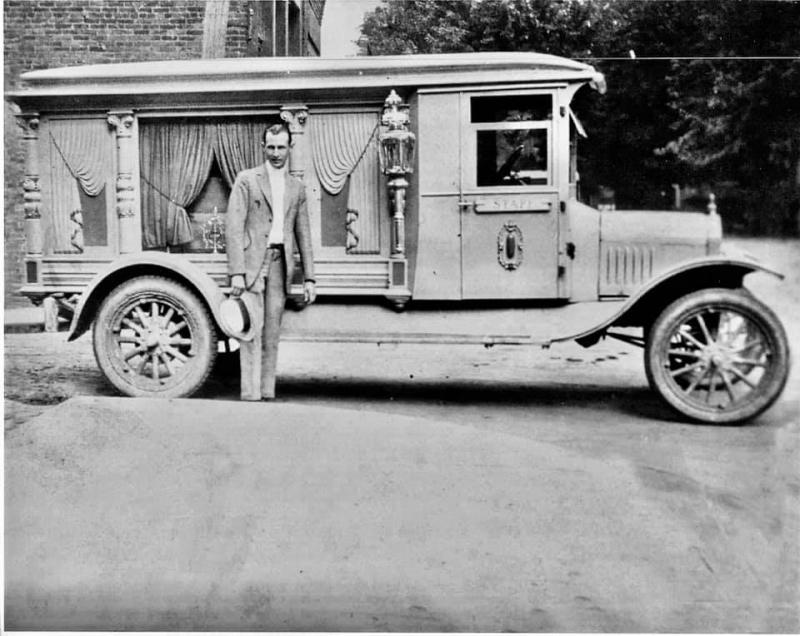
L.G. Stapf  and hearse at the time of Mary Magdalene Pitts death

Stapf Funeral Home at the time of Mary Magdalene Pitts death

George Kaye Woods

Mary Magdalen Pitts in school class photo

Original article can be found here: 
http://www.greenupbeacon.com/pitts


ph: (606) 356-7509


Forgotten Kentucky: The Day a Fighter Plane Chased a UFO Over Fort Knox

  Courtesy of The Morehead Minute Newsletter: By Joe Clark For The Morehead Minute Long before The X-Files , before Project Blue Book becam...